As usual in the build-up to a Steve Jobs Keynote, the excitement online is palpable, made all the more so by Apple’s usual culture of secrecy. Check out this posting reporting a large number of Apple boxes being shipped with special instructions not to open… At least we only have to wait a day or so to find out what’s inside!
Monthly Archives: January 2007
30 Days – Religious Perception

I’ve mentioned 30 Days, the series created by Morgan Spurlock after he made Super Size Me earlier in the year. Recently the second series of 30 Days has been showing in the UK, and after our trip to Canada we had one episode left to watch, an episode which finds a confirmed atheist who spends 30 Days living with a devout Christian family, attending both their services and Bible study classes. Interestingly both the atheist and the Christian parents had been brought up in Christian families, and both had reached a point where they had made a big faith decision, in one case having been brought up a Methodist to become atheist, and in the other to move from being Catholic to the McKinney Fellowship Bible Church that the family were now attending.
Unlike some of the other episodes, there wasn’t any significant change in the beliefs of any the participants, although there certainly was a greater understanding of the position of each group. What I found really quite surprising though is quite how much the attitudes and behaviour of most Americans differs from what their constitution actually says.
The first amendment to the US Constitution explicitly forbids the government from establishing a state religion or even being seen to prefer a certain religion, nor to prohibit the free exercise of religion. So unlike the UK, where prayer is a legal requirement in schools for example, any sort of prayer is regarded as unconstitutional. Having said that the show featured in background segments a number of problems that atheists face. For example the show featured a group of atheists who formed a church – an association of people sharing the same set of atheist beliefs – and applied for a tax break that was given by the government to any church. The application was thrown out because they didn’t believe in any sort of deity or divine being. As the group pointed out, they believed this to be contrary to the first amendment. They also highlighted that the decision in 1956 to officially adopt ‘In God We Trust‘, and to put it on bank notes also contravenes the amendment, as does the Pledge of Allegiance – particularly since the words ‘under God’ were added in 1954.
Interestingly the daughter of the atheist in the programme had refused to use the words ‘under God’ when reciting the pledge at school, substituting ‘under the Government’ instead, and been bullied by other students for doing so. This highlighted quite how badly atheists are seen in the US. The programme quoted figures from a survey of 2000 US citizens that found atheist at the bottom of the list of people “sharing their vision of US societyâ€?, and the group in society that respondents were least happy for their offspring to marry. Compare this with the results of the regular Gallup poll into Evolution, Creationism and Intelligent Design which finds that 53% of respondents believe that ‘God created man exactly as the Bible describes it’ and, the pretty widespread misunderstanding during the street vox pops in the programme that atheists don’t believe in anything at all you can start to see why they are unpopular. For the record, the programme highlighted that atheists believe in a lot of things including humanism and naturalism, and at one point, one person questioned on the street even described atheists as both progressives and communists (obviously hadn’t come across the biblical verses that underpin Christian Communism then…).
The programme also took a look at a couple of Christian groups and places to balance out the atheist group, including a group that I’m sure Howard would appreciate, Denver based Biblically Correct Tours who were shown giving tours of the Denver Museum of Nature and Science and trying to fit dinosaurs into the creation story (according to the tour guide shown on the programme they were created on the same day as humans and co-existed with human beings before their extinction – there is apparently no evidence that they existed millions of years before humans even appeared). The followed this up with a visit to the Holy Land Experience theme park in Florida, which alongside a daily passion play includes a number of Christian themed exhibits, and even includes the worlds largest model of Jerusalem at the time of Jesus. The sequence also included a shot of the price list at the concession stand – King David Chicken Sandwich anyone?
The whole irony of the programme was that a country like the US that seems proud of it’s heritage separating Church and state is largely Christian, and yet the UK, where Christianity is the state religion as a culture is significantly more secular.
Windows Vista – First Experiences
So this afternoon I decided to give Windows Vista a go, to be more precise, Windows Vista x64…
After a bit of messing around with Partition Magic, and some deleting of installed software I managed to clear enough space for a new partition, with just enough space for an install, but not much else. Since I have a backup of the machine anyway, and the machine is not my main computer, I decided to get the full experience I should just go the whole hog and install onto the main partition – after all there is not much point in having the OS installed if I have no space to install software!
So I set the installation going. Helpfully it detected my current Windows XP install, and moved it to a folder called Windows.old. Upgrading wasn’t an option since as a quick look at the upgrade matrix published back in July my existing XP64 installation won’t upgrade.
Now I guess this is proof that I’ve been in MacOS X too long, as something like this isn’t usually a problem, as the recommended way to upgrade MacOS X is to do a clean install, and then use the migration assistant described in detail over at Mac Dev Center.com to pull all the relevant settings and applications out of the backed up folders.
Now I’m aware that the PC equivalent can’t do applications, but it seems that even though the install creates the Windows.old folders, it can’t cope with pulling settings from it – it only works with another machine.
Ok, not too much of a problem, I can just mount up my backup image in a virtual machine using something like Virtual PC or Virtual Server – but no, neither of these can run under Vista. In much the same way as with the various editions of Visual Studio (even Visual Studio 2005 – their current version), they don’t work, the best option is to run a beta version of the upcoming release.
Having said that, it’s not all bad news. The driver support in the 64-bit Vista is better than XP64. All but the sound driver and the wireless networking installed off the installation DVD. The sound driver the OS found online, and it was only the wireless networking that had me rummaging around on the internet.
It does look rather pretty too, with some font changes, and various bits of MacOS X-ish eye candy. As with Office 2007 if you scratch at the new paint job a bit, you can quickly find bits of classic windows peeking through. Quite often if you click through some of the nice user friendly screens, or go for an advanced option you find a decidedly familiar window popping up, scarcely changed from Windows XP.
The new security features are rather amusing at the moment, but I suspect will become rather annoying. As Coding Horror highlights, referring to an original article by Paul Thurrott, Microsoft have opted for their traditional security through warning dialogs – as in a number of previous products, when something happens that could be potentially risky, it displays a warning, with the option to allow, or cancel what is happening. However it rarely gives much detail about what is going on, and pressing allow will allow it to carry on. Ok but these dialogs come up so frequently, even for really basic tasks, that I am sure most people will just ignore them. Bear in mind that I’m running as an Administrator currently – if I were a normal user it would be asking for passwords all the time. The other security feature that had my jaw on the floor was when I tried to delete an empty, but protected folder on my hard drive. Vista correctly informed me that the folder belonged to another user, and was protected. However it then offered to unprotect it for me. Without asking for a password or anything, it took ownership of the folder, changed the access rights and deleted it! True you can turn this off – but it somewhat defeats the object, and if it’s off, the machine keeps complaining about the fact too. Hopefully I can try and find some happy medium between the annoyance of totally on, and the complaining of totally off, but I doubt it.
So will Vista have me switching back full time to a PC – not a chance. On a positive note it is better than XP, but still it is not a patch on MacOS X, and that is even before we see Leopard…
Update: Ironically, and totally coincidentally it seems Dave Oliver has been giving Vista a try too. The big difference is that he’s using Vista 32 – where the upgrade advisor works (on 64-bit it suggests running it, and takes you to the download page. It’s only when you download the thing that it says it won’t work on 64-bit operating systems.) It seems he’s had many more driver issues than me, significantly that it failed to recognise his graphics card.
I’m currently seeing how various games run under Vista – annoyingly the security features are coming in to play and the OS is asking again for permission when I insert every new CD of a multi-CD installation, despite it being the one installer running the whole process.
Torchwood Goes Out on a High
I commented a few weeks ago about how bad Torchwood was getting – thankfully it turned out that in general the episodes improved a good deal, so the final double episode we sat down to watch as part of post-holiday catch-up was really rather good.

Interestingly, although shown as a double episode, this was really two separate episodes shown back to back. The first, Captain Jack Harkness appeared to be primarily a character piece where whilst investigating reports of 1940’s music coming from a derelict dance hall, Jack and Tosh find themselves pulled back in time to a dance in 1941 – a dance attended by the real Captain Jack Harkness the day before he looses his life in the war – the man whose identity Jack has assumed. However the episode also introduces the character of Bilis Manger, who is the manager of the dance hall back in 1941, and also the caretaker in the present day – looking no older. In both cases he has the same, clock filled office. He also, back in 1941 has a file marked ‘Torchwood’ and is also taking pictures with a Polaroid camera that hasn’t yet been invented. Subsequently he sabotages a plan by Tosh to leave equations to safely open the rift to bring them back, trying to trap them in the past.
Meanwhile in the present day, the team are arguing over how to bring Jack and Tosh back, and when they discover that the equations to open the rift are incomplete, Owen opens it anyway, despite being shot by Ianto in the process. This brings Jack and Tosh back to the present day, but Bilis Manger is not captured.

The opening of the rift leads directly to the events of End of Days. Having incorrectly opened the rift, fractures in time start to occur – UFO’s are sighted over the Taj Mahal, soldiers from the English Civil War, and Roman times are appearing in present day Cardiff, and bubonic plague breaks out at the local hospital. Various of the Torchwood team also receive visions of dead loved ones, all suggesting that opening the rift fully would be the way to fix the problems. In amongst this, the mysterious Bilis Manger appears again, this time in his shop, ‘A Stitch in Time’ which sells antique clocks and time pieces. When questioned, he suggests again that the rift should be opened, and also confirms that he can move through time as easily as walking into another room. He demonstrates when Jack tries to take him into custody.
Jack leaves, but Gwen goes back, and meets Bilis again. He shows her a vision of the future where her boyfriend has been brutally murdered. This convinces Gwen to bring Rhys to the safety of the Torchwood base, however Bilis appears and murders him in the cells. This leaves everybody in Torchwood except Jack convinced that the rift should be opened. The reason why everybody needs to be convinced becomes clear – to open the rift fully requires authorisation of all the Torchwood staff via iris scans. Utterly convinced that they need to open the rift, Owen shoots Jack dead to obtain the scan.
As we have previously learnt from the episode Everything Changes, Jack cannot die – however he takes time to recover from any experience such as being shot, so he is unable to stop the rift being opened. Although all the anomalies, including the murder of Rhys resolve themselves, the opening of the rift also releases Abaddon, a Biblical demon that, like the Beast in the Satan Pit has been trapped beneath the rift – indeed the creature is referred to as ‘the son of the Beast’. It transpires that Bilis knows of the presence of the demon, and has been manipulating events in order to release him.
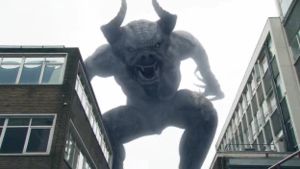
The giant Abaddon stalks Cardiff, killing anyone who falls under his shadow, and Jack realises that only someone who cannot die such as himself can defeat the demon. He goes to face him alone.
As with the other victims when the shadow of the demon reaches Jack, he is affected, but he doesn’t die immediately eventually white flows of energy form between Jack and the demon, and it appears that the energy that is keeping Jack alive, is too much for the demon, and Abaddon dies. However it leaves Jack apparently dead too. Most of the Torchwood team are convinced Jack is now really dead, except for Gwen, who keeps vigil by his side. Gwen is proved to be right, and after many days, Jack wakes up, weak and shaken, but alive.
We then get an intriguing epilogue. With Jack catching up on paperwork in his office, he has a conversation with Gwen. He again suggests that he ‘needs the right kind of Doctor‘, to help his condition. Then the hand that has been kept throughout the entire series, the Doctor’s hand from The Christmas Invasion starts to glow, and a familiar sound is heard, that of the engines of a TARDIS landing. Jack runs towards the sound, whilst Gwen stands shocked. When she gets over her surprise she follows, but Jack is gone.
It is well known that Jack is due to return to Doctor Who next season, in the eleventh episode Utopia. However the exact details of how and why he returns are not yet clear. From the end of End of Days most people are assuming that it is the Doctor who has just picked up Jack. But why pick him up so quickly without stopping – and if he is able to pick Jack up so accurately – knowing exactly where he is, why hasn’t he done so sooner? On the other hand, could it be accidental, the TARDIS briefly appearing, and Jack jumping on board – the last time Jack met the Doctor he looked somewhat different, so there doesn’t seem to have been time for any sort of discussion of the change of face.
However what is intriguing is that although you hear a TARDIS materialise, you never see whether it is the TARDIS, nor do you see the Doctor. All you see is Jack running towards the sound, and subsequently being gone – could it be a kidnapping? Remember also that Bilis Manger was again not captured or destroyed – Jack’s apparent immortality was a closely guarded secret, not known to even all of the Torchwood team. Certainly I would not be surprised to find that Bilis Manger is more than he seems, so maybe a careful watching of the details of Utopia is in order. A number of Doctor Who forums are discussing theories (including the fact that ‘Mister Bilis Manger’ is apparently an anagram of ‘I’m Master, bring Lies’), although the opinion that people are reading too much into it all seems to feature pretty prominently too – I guess we’ll have to wait to the spring to find out!
Letting the Vicar Loose with Candles
After all the concerns over Christingles, Ruth Gledhill highlights a story that shows that it’s not only the children who need to have a close eye kept on them in Church with all the candles around at Christmas.
This is Graham Kings, Vicar of St Mary’s Islington giving a Christmas Sermon, and probably regretting the bright idea to have someone with a video camera and an internet connection tape his sermons…