Category Archives: Doctor Who

Torchwood Goes Out on a High

I commented a few weeks ago about how bad Torchwood was getting – thankfully it turned out that in general the episodes improved a good deal, so the final double episode we sat down to watch as part of post-holiday catch-up was really rather good.

300px-captain_jack_harkness.jpg

Interestingly, although shown as a double episode, this was really two separate episodes shown back to back. The first, Captain Jack Harkness appeared to be primarily a character piece where whilst investigating reports of 1940’s music coming from a derelict dance hall, Jack and Tosh find themselves pulled back in time to a dance in 1941 – a dance attended by the real Captain Jack Harkness the day before he looses his life in the war – the man whose identity Jack has assumed. However the episode also introduces the character of Bilis Manger, who is the manager of the dance hall back in 1941, and also the caretaker in the present day – looking no older. In both cases he has the same, clock filled office. He also, back in 1941 has a file marked ‘Torchwood’ and is also taking pictures with a Polaroid camera that hasn’t yet been invented. Subsequently he sabotages a plan by Tosh to leave equations to safely open the rift to bring them back, trying to trap them in the past.

Meanwhile in the present day, the team are arguing over how to bring Jack and Tosh back, and when they discover that the equations to open the rift are incomplete, Owen opens it anyway, despite being shot by Ianto in the process. This brings Jack and Tosh back to the present day, but Bilis Manger is not captured.

150px-bilis_manger.jpg

The opening of the rift leads directly to the events of End of Days. Having incorrectly opened the rift, fractures in time start to occur – UFO’s are sighted over the Taj Mahal, soldiers from the English Civil War, and Roman times are appearing in present day Cardiff, and bubonic plague breaks out at the local hospital. Various of the Torchwood team also receive visions of dead loved ones, all suggesting that opening the rift fully would be the way to fix the problems. In amongst this, the mysterious Bilis Manger appears again, this time in his shop, ‘A Stitch in Time’ which sells antique clocks and time pieces. When questioned, he suggests again that the rift should be opened, and also confirms that he can move through time as easily as walking into another room. He demonstrates when Jack tries to take him into custody.

Jack leaves, but Gwen goes back, and meets Bilis again. He shows her a vision of the future where her boyfriend has been brutally murdered. This convinces Gwen to bring Rhys to the safety of the Torchwood base, however Bilis appears and murders him in the cells. This leaves everybody in Torchwood except Jack convinced that the rift should be opened. The reason why everybody needs to be convinced becomes clear – to open the rift fully requires authorisation of all the Torchwood staff via iris scans. Utterly convinced that they need to open the rift, Owen shoots Jack dead to obtain the scan.

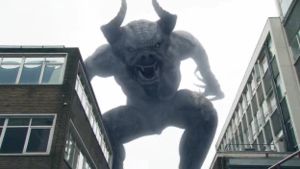
As we have previously learnt from the episode Everything Changes, Jack cannot die – however he takes time to recover from any experience such as being shot, so he is unable to stop the rift being opened. Although all the anomalies, including the murder of Rhys resolve themselves, the opening of the rift also releases Abaddon, a Biblical demon that, like the Beast in the Satan Pit has been trapped beneath the rift – indeed the creature is referred to as ‘the son of the Beast’. It transpires that Bilis knows of the presence of the demon, and has been manipulating events in order to release him.
300px-end_of_days.jpg

The giant Abaddon stalks Cardiff, killing anyone who falls under his shadow, and Jack realises that only someone who cannot die such as himself can defeat the demon. He goes to face him alone.

As with the other victims when the shadow of the demon reaches Jack, he is affected, but he doesn’t die immediately eventually white flows of energy form between Jack and the demon, and it appears that the energy that is keeping Jack alive, is too much for the demon, and Abaddon dies. However it leaves Jack apparently dead too. Most of the Torchwood team are convinced Jack is now really dead, except for Gwen, who keeps vigil by his side. Gwen is proved to be right, and after many days, Jack wakes up, weak and shaken, but alive.

We then get an intriguing epilogue. With Jack catching up on paperwork in his office, he has a conversation with Gwen. He again suggests that he ‘needs the right kind of Doctor‘, to help his condition. Then the hand that has been kept throughout the entire series, the Doctor’s hand from The Christmas Invasion starts to glow, and a familiar sound is heard, that of the engines of a TARDIS landing. Jack runs towards the sound, whilst Gwen stands shocked. When she gets over her surprise she follows, but Jack is gone.

It is well known that Jack is due to return to Doctor Who next season, in the eleventh episode Utopia. However the exact details of how and why he returns are not yet clear. From the end of End of Days most people are assuming that it is the Doctor who has just picked up Jack. But why pick him up so quickly without stopping – and if he is able to pick Jack up so accurately – knowing exactly where he is, why hasn’t he done so sooner? On the other hand, could it be accidental, the TARDIS briefly appearing, and Jack jumping on board – the last time Jack met the Doctor he looked somewhat different, so there doesn’t seem to have been time for any sort of discussion of the change of face.

However what is intriguing is that although you hear a TARDIS materialise, you never see whether it is the TARDIS, nor do you see the Doctor. All you see is Jack running towards the sound, and subsequently being gone – could it be a kidnapping? Remember also that Bilis Manger was again not captured or destroyed – Jack’s apparent immortality was a closely guarded secret, not known to even all of the Torchwood team. Certainly I would not be surprised to find that Bilis Manger is more than he seems, so maybe a careful watching of the details of Utopia is in order. A number of Doctor Who forums are discussing theories (including the fact that ‘Mister Bilis Manger’ is apparently an anagram of ‘I’m Master, bring Lies’), although the opinion that people are reading too much into it all seems to feature pretty prominently too – I guess we’ll have to wait to the spring to find out!
The Runaway Bride

350px-the_runaway_bride_doctor_who.jpg

So after all the building excitement, we’ve had The Runaway Bride, this years Doctor Who Christmas Special.

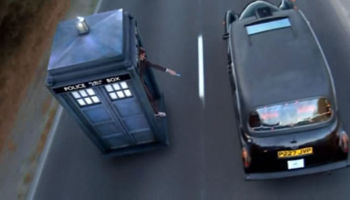
The episode was a definite fast action romp, with the previously leaked chase sequence turning up pretty early on, as Donna, the bride in question takes a taxi in order to try and get back to her wedding, which from the pre-credit sequence, she mysteriously vanished from as she was walking down the aisle.

The question of how she transferred across billions of miles of space from her wedding into the TARDIS was explained as being due to her being saturated in Huon particles, a small amount of which are present in the heart of the TARDIS itself. Presumably the large amounts of power that the Doctor had been using to make his last communication with Rose resulting in the long distance attraction of the particles in Donna bringing her to the TARDIS. The Doctor uses the same effect later in the episode to bring the TARDIS to Donna.

It transpires that Donna has been inadvertently working at a company that was formerly part of Torchwood, but following the destruction of the London Torchwood at the end of Doomsday, the company is now being used as a front for the Racnoss, the last of whom is using the resources of the company to try and revive members of her race who had been hidden millions of years ago in the core of the Earth. The aforementioned Huon particles being used to reactivate them, but needing to be in a large enough concentration, Donna has been used as a human container, with the particles being gradually built up over the previous six months. The wedding is also part of the plan, as the Racnoss human agent had agreed to marry Donna in order to allow him to continue the plan.

Needless to say the Doctor foils the plan and saves the Earth, and the episode finishes with the Doctor asking, and Donna refusing to go with him. Instead, the Doctor uses the TARDIS to produce a snow shower (which probably explains the unseasonal London snow fall in Eastenders I guess) and then departs.

All in all it was a quite entertaining hour for Christmas Day. Donna was definitely different from Rose, and unlike last Christmas where Tennant spent the majority of the episode incapacitated, this time around it was definitely him who was the star of the show. The episode carried on at a breakneck speed, with some spectacular sequences. The TARDIS chase was definitely one of the highlights – and definitely something they couldn’t have done before the advent of CGI. Having said that, the spectacular Racnoss – a giant spider, wasn’t produced in the same way – this was apparently actually built.

The story was dated as present day, dropping it in as a further part of the latest continuity/dating hiccup that I expect will rival the UNIT dating controversy from the seventies for confusion. In much the same way, Rose was dated present day, and then subsequent return visits to Earth were said to be months in the future, particularly Aliens of London which is twelve months later. This pushes the events of both The Christmas Invasion and Doomsday into the future, making both the present day dating of Runaway Bride and the main Torchwood series somewhat problematic.

Anyway, as with last year, the episode was followed by a preview of the upcoming series, with flashes of Martha Jones the new companion, some nice shots of the Globe Theatre from the upcoming Shakespeare episode amongst other things. However, at the end of the trailer we also get confirmation of the return of the Daleks, in a story that is set in Manhattan in the 1930’s. Certainly much to look forward to.

Invasion

One of the many treats for Doctor Who fans this Christmas, particularly those who appreciate the original series is the release on DVD of The Invasion an eight part adventure for Patrick Troughton’s Second Doctor featuring the Cybermen.

As the story opens, the Doctor is having problems with the TARDIS, which materialises above the dark side of the moon. Unfortunately it’s presence is not welcome, and a missile is launched at the time machine, with the the Doctor evading it just in time. The TARDIS comes to rest in a cow filled field, and with the Doctor needing parts to fix the fault, the TARDIS crew have to go off to find someone to help. The Doctor and his friends head for London to look up an old friend, but find that he has gone away, leaving his home in the care of a Professor Watkins and his niece – but Professor Watkins has disappeared whilst working for International Electromatics. The Doctor goes to investigate, and discovers that Tobias Vaughn, the sinister head of International Electromatics is working with the Cybermen to conquer the world. Vaughn believes that he can use the Cybermen, who he believes want only the natural resources of the Earth in order to gain power, and has been using Cyberman technology to infiltrate key government roles in order to keep his plan secret. Over a number of months he has been bringing the Cyberman army to Earth and hiding them in the London sewers. However the Cybermen have other plans, and want to convert the entire human race to Cybermen, and tell Vaughn that he can only lead the Earth once he has been converted. Ultimately Vaughn realises that he cannot control the Cybermen and joins with the Doctor to defeat them.

If that plot seems somewhat familiar, it should, as it is remarkably similar to the plot of Rise of the Cybermen, a similarity I commented on at the time that episode was first shown. Aside from the difference that John Lumic the sinister head of Cybus Industries creates the Cybermen in the later story, a significant number of plot elements are the same. The take-over in both stories is by means of secret circuits in electronic devices, in both stories the wealthy industrialist believes he can control the Cybermen but ultimately can’t, there are even quite subtle similarities, for example in both stories the industrialists have a loyal assistant who doesn’t want to be taken over, and in both the industrialists whilst having been augmented by cyber-technology, ultimately do not want to be fully converted. The production team for Rise of the Cybermen acknowledged the similarities between the two stories by naming the transport company that move the Cybermen International Electromatics after the company in the original story.

anim_doczoe.jpg

The major selling point of this DVD though is that this is the first release of the complete story. Whilst The Invasion was released on video in 1993, the missing first and fourth episodes were replaced with Nicholas Courtney explaining the missing plot, this time, as I mentioned a few months back the missing episodes have been recreated using the original soundtracks of the episode which have been preserved, and animation produced by the team at Cosgrove Hall.

I have to say that the new animated episodes look great. Ironically in certain respects I think they look better than the original episodes. For example the strange alien machine that Vaughn uses to communicate with the Cybermen first appears at the climax of the first episode, so appears animated, and looks decidedly better than the shot of the actual prop that appears in episode two. Having said that, the big disappointment for the animators I bet was that they didn’t get much opportunity to animate Cybermen, as their first appearance in the story is in the final scene of episode four. Certainly you can understand why the animators chose the scenes they did for the initial trailer now.

That actually serves to highlight one of the big differences between The Invasion and modern Doctor Who – this is very slow burn. The presence of the Cybermen is not revealed until the very end of episode four, with the first four episodes being the Doctor investigating International Electromatics, and whilst you subsequently discover that he gets pretty close, the monsters don’t actually appear. Episodes four to eight are the Doctor dealing with the actual invasion, complete with creepy encounters with Cybermen in the sewers, and the iconic images from the story with Cybermen on the steps of St Pauls. Strangely enough though for such a long story, elements of these episodes seem decidedly rushed – on several occasions you get key moments in the defeat of the invasion which are referred to but not seen, and even the final scene where the Doctor and his friends leave to a new adventure seems very quick. Maybe I’m just getting rather used to the longer character moments we have in the new series.

Having said that, it is an excellent story, and it is great to be able to see the whole thing once again. The story came at a key moment in time for the series. Patrick Troughton had decided to leave, and with the advent of colour TV, the producers had decided to make the series more Earth based, because they believed (rather as the team does today) that they didn’t have the budget to do alien worlds justice. As such The Invasion can be seen as a pilot for the UNIT stories that followed during the third Doctor era. So as both a key point in the development of Doctor Who, and a great story in it’s own right, it is a definite must own purchase for a Doctor Who fan.

Look Who’s Top

So having been released on Monday, guess what is top of the chart for iTunes downloads, and has been all week – Murray Gold’s Doctor Who Soundtrack Album. It also has an almost perfect run of glowing reviews, with only one person knocking off a mark for the fact that the recording of Song for Ten isn’t the one that was used in last years Christmas episode, but a new arrangement.

Anyway, looking at the track list there is a broad selection of extracts from the first two seasons of the new version of the series. Unlike the bulk of the eighties series, with their largely electronic incidental music produced by Radiophonic Workshop, and subsequently Keff McCulloch, Mark Ayres and Dominic Glynn, this soundtrack is much more orchestral, however not nearly so orchestral as the John Debney soundtrack for the ill fated Doctor Who television movie in 1996.

The album also shows the benefit of having a single composer for the whole series, so track 3 of the album is the Doctor’s Theme, a haunting, mournful solo soprano, variations of which you often find intertwined into other tracks throughout the album, and track 14 is Rose’s Theme elements of which appear at key moments for her. But having a single composer certainly doesn’t mean that everything sounds the same, with styles varying widely from the electronic heavy music from Tooth and Claw, through to the classical themes for Madame de Pompadour and the beautiful piano themes for episodes such as Father’s Day. Amongst the other gems on the album you also get the doom laden choral theme for The Daleks, and the memorable solo strings for the Impossible Planet. Alongside that you also get two songs – Song for Ten and Love Don’t Roam – the first, as previously mentioned coming from Christmas Invasion, the second due to appear in this years Christmas episode The Runaway Bride.

Last but not least, the album includes two versions of the main title theme, opening with the 41 second main theme used on the programme, and ending with a full version, parts of which have been used as the closing theme throughout the second season. However, I still have to say (and I know I’m in a small minority in this) that I’m with John Debney in that the arrangement needs to be changed to get a good orchestral version of the theme. Whilst part of Murray Gold’s brief was to keep it close to the original theme, the John Debney version changes the arrangement significantly, lowering the tempo and opting for purely orchestral, and is all the better for it. (Of course the ultimate version of the theme still has to be Bill Bailey’s Belgian Jazz version…)

Having said that, the Doctor Who Soundtrack by Murray Gold is an essential purchase for any fan, and is certainly a great listen.