Tag Archives: BBC

BBC Give Some Ground

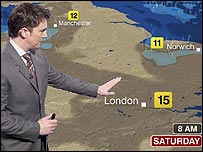
After a couple of weeks of giving out explanations of perspective – and totally missing the point, the BBC have altered the angle at which the UK is viewed in their forecasts.

Before and After

However, since the online service shows perfectly well that they can address a number of the other issues, including those of people with colour blindness being unable to distinguish the brown shades (and even without being colour blind I have problems with the new wind arrows!) I suspect that the discussion is not yet over!

Eurovision Results

So in a break with tradition, the bookies favourite has won Eurovision. After a slow start, Greece came through for a convincing win.

What is somewhat more interesting is the rout of the old Europe that started with Ireland failing to qualify for the first time ever on Thursday continued with the bottom four tonight being Germany, France, the UK and Spain. What is interesting is that those four are also the four countries that provide the largest contributions to the running of the contest, and therefore are not required to qualify next year. Having said that, the presenter of the BBC Eurovision behind the scenes show after the main competition made a rather pointed comment speculating that if the countries that pay for the show don’t get many votes, they’ll lose interest and not bother supporting future contests!

Political voting was in evidence as always, which is maybe why we did quite so badly. The Balkans especially all voting for each other. Having said that, the island nations – UK, Ireland, Malta and Cyprus all provided votes for each other, so I guess there is a little voting block going on there too. There were one or two surprises though, with Monaco, usually a reliable source of votes for France failing to give it any points at all. However maybe that is a comment on the ongoing attempts of France to end Monaco’s position as a tax haven.

Wig Wam

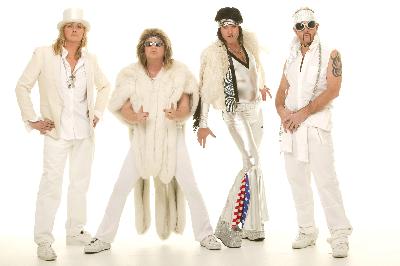
In the Peat household the winning Greek song was not a favourite, we thought that the Maltese song that came second was a lot better. The second favourite with the bookies, Norway, were well down, despite a quite amazing glam rock look that has to be seen to be believed. However, one of the biggest worries was that enough people in the UK voted for the Moldovan granny to get her 2 points from the UK televote!

Eurovision

So it’s that time of year again, time for the annual review of who likes who in Europe, thinly disguised as a song contest, which takes place in Kiev tomorrow night. Apparently, other parts of Europe take the whole contest, started to promote European harmony and song writing, very seriously. However in the UK it is viewed as a combination of camp entertainment and a musical train wreck thanks in no small part to the commentary provided by Terry Wogan for the BBC.
Eurovision Logo

There has already been one bit of shock news, with Ireland being booted out at the semi-final stage – a far cry from their run of wins a few years back where it almost got to the point that they couldn’t afford to host the competition for another year! Of course, as the British stump up a lot of the cash to stage the competition, we automatically get through to the final, however badly our song does each year.

The marathon show splits into two parts. In the first part the 24 countries (14 who either scored well enough last year, or like the UK provide a lot of the cash to run the competition, and 10 who qualified from the semi-final on Thursday) out of the original 39 will each play their song. In between each song, the host country, this year Ukraine – who won the previous years competition – gets a chance to show a series of brief films highlighting aspects of the country. After the songs, there is an interval act, that is sometimes more memorable than the songs (remember Riverdance? Bet you can’t remember the song that won in that year though!), which gives everybody in the 39 participating countries a chance to vote by phone.

After that comes perhaps the most bizarre part of the whole affair, when one by one, each country gives marks from 1 to 12 points, based on the top ten songs in the results of their phone vote. This method of course gives small countries such as Malta equal voting power to populous countries such as Russia. It is also the point where you get the impression that there is something very strange going on. Greece and Cyprus will always give each other top marks. All the Baltic countries vote for each other, as do all the parts of the former Yugoslavia. All the former Soviet republics always give Russia a big vote. The UK always tends to place Ireland pretty highly, but our points are very dependant on how popular we are in Europe at the time. For example when Tony Blair was elected in 1997, we won. However after a number of years of the UK making itself unpopular, when the UK joined the USA in invading Iraq, we got “nil-point”. (It is worth saying that in that year we also had a singer who started in a different key from the backing track, so we didn’t even pick up one or two votes as we usually do). As our entry last year has said “The results are not important, as long as you don’t end up with zero“.

If you’re really interested, the Wikipedia has an extensive section on the contest, including the bizarre voting patterns, and the other rules and regulations – plus it also has the results of every single contest since the first in 1956.

Current favourite looks to be Greece. However as is usual the bookies will have got it totally wrong, and Terry Wogan will be left amazed at the voting!
Shock Horror – The British Debate The Weather

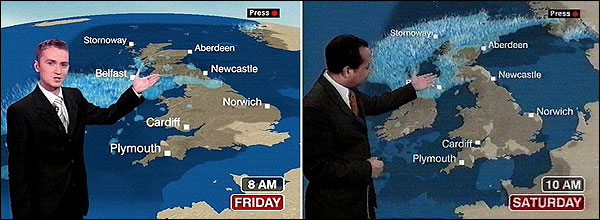
Not content with talking about the actual weather, the debate today has been over the new style BBC weather forecasts.

Old style New style

Several times during the day BBC presenters have turned up explaining the new style forecasts in the face of a majority of people who don’t like the new style forecasts. The broad issues are as follows:

  • The UK is coloured brown not green.
  • The new perspective view makes the south look a lot bigger than the north.
  • The flying over the UK effect seems to give some people motion sickness.
  • Where are the distinctive BBC symbols?
  • The counter arguments I’ve heard so far are as follows:

  • Brown makes it easier for people to distinguish the cloud shading.
  • Yes it does(!)
  • We don’t do it as fast as we could…
  • Because of their size in relation to the map, the old symbols are inaccurate.
  • I have to say, after the first day, I do rather agree with all of the objections. Whilst I accept that the new style is more accurate, with the lack of many places on the main map, I still can’t totally accurately place myself on the map, so accurately knowing the weather at a particular spot is pointless if I don’t know to the same accuracy where that spot is located. As to distinguishing browns, I also have difficulty spotting the fairly subtle variations in brown shades for the cloud cover, and a similar, although lesser problem with the blues for rain. Obviously they had a focus group with 20-20 vision and a big TV screen!

    However, one interesting discovery I found, was in the online service, which uses the same software, complete with the familiar top down map, and the familiar symbols. It does stink a bit of kids with their new toys, so maybe in the coming weeks we’ll see the familiar symbols reappear, I hope so, at least then I’ll be able to work out the weather from the TV forecasts.

    Update: The debate has even reached Westminster! Today the MP for the Western Isles in Scotland put down a motion calling for the BBC to reconsider a map that gives a distorted view of Scotland. In addition the BBC has had 248 calls about the new weather – only 8 in favour. One is really tempted to ask quite who they consulted for their audience research.

    The Monastery

    Last night we watched the first of The Monastery, a new series on BBC2 where five men spend forty days at Worth Abbey, a community of Benedictine Monks.

    The group is a pretty mixed bunch ranging from a mature student who whilst attending church, has a lot of big, deep theological issues to deal with, through to a worker in the sex industry with no religious background, or belief in God.

    Perhaps the most interesting of the men is a former member of the UDA, a Protestant terrorist organisation in Northern Ireland. Having spent much of his early life in prison, he has a lot of issues to resolve. He also said what I found to be one of the most touching statements about his experience in the first few days. He described being in the Monastery as being his idea of heaven, because the twenty or so monks knew what he had been in the past, but didn’t judge him, just accepting and loving him anyway, just as he was.

    It certainly was an interesting programme, and I’m looking forward to the rest of the series.