Tag Archives: Robert Scoble

CERN Tour – Big Science with some Internet History

As usual I’m a little behind with watching some of the videos I’m subscribed to. However, this afternoon I got round to watching the ScobleShow video tour of CERN near Geneva.

CERN is very much science on a big scale, with the new accelerator the Large Hadron Collider running for 27km under the mountains. Not surprisingly, to support all of this research, they’ve needed a similar level of computing resources. The two people doing most of the talking on the video are Ben Segal and Jean-François Groff, who were both involved in key parts of the story of the birth of the World Wide Web along with Tim Berners-Lee. Ben Segal was key in introducing TCP/IP into the organisation, and at one point in the video talks about the significant internal arguments that took place over using the North American protocol over European alternatives. Jean-François Groff worked with Tim Berners-Lee on the first browser and the underlying protocol.

Alongside the history, you also get a bit of background as to the main work at CERN looking around the on site museum. The video then finishes with a look at the data centre, with a discussion of quite how much the contents of the data centre have changed. Definitely an interesting video.

Hi-Tech Contracting with ODesk

The ScobleShow this week highlighted an interesting way for both freelance programmers to find work, and for companies to hire them through a site called ODesk. Alongside the matching services, the site also handles paying the contractors, and even allowing the software companies to check up what work their contractors are doing thanks to it’s built in remote desktop viewing functions.

Essentially it is doing what some developers I know have done for a while. For example one former colleague did software development work remotely for a company in the USA whilst house sitting for his parents in Australia, all ODesk does is take the complication out of the arrangements allowing a wider range of companies and software developers to be involved.

Certainly if you’ve got reasons why you can’t work a regular software development job, or live in a location where there just isn’t the software development work available with your relevant skills, it certainly seems like something that is worth checking out. It’s probably also worth a look if you’re a software company struggling to find suitably qualified staff. However, if you are a developer I would suggest that it would definitely be wise to take some professional advice over the legal and financial intricacies of working remotely in this way, particularly with regards to tax for example.

Anyway, Robert Scoble interviews the people behind the company here:

and this is a demo of the system:

Playing Trains

I’ve just finished watching the latest of Robert Scoble’s Photowalking videos with Thomas Hawk. This time Scoble reveals himself as a bit of a train buff, as they go around the California State Railroad Museum. Thomas has some great close up shots up on his own blog. Maybe someone should take Scoble up to our own National Railway Museum next time he is in the UK.

Anyway, it was strangely appropriate, as whilst watching that, I was going through the rather tedious process of rebuilding my Microsoft Train Simulator install following my switch to Vista. Unfortunately the package is one of the many that have hiccups with the new security model under Vista, although setting the application to run as an administrator has thus far seemed to solve most problems.

What takes the time though, is replacing all the add-on’s I had installed. In total, my previous install had almost 4gb of various trainsets from around the world, including quite a few British add-ons from Making Tracks, and a couple of US outline add-ons too.

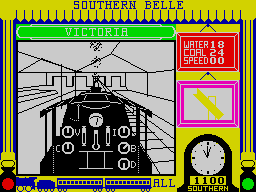
yr19_45c.gif

It has to be said, that the electronic train-set has come a long way since the first one appeared on the market back in 1985. Southern Belle simulated the London to Brighton line, thanks to wire-frame graphics of key landmarks on the route. Although there were various activities, essentially you were limited to that one route.

Microsoft Train Simulator gives you a potentially infinite world in which to play, thanks to the pretty open architecture. So whilst the original release included routes from the USA, Japan, Austria and the UK, a pretty impressive add-on industry has grown up.

56_springfield_3.jpg

The game engine is not surprisingly much more powerful, allowing you to produce quite atmospheric views, a far cry from the old wireframe graphics back in 1985.

However, the game wasn’t quite the success that was hoped for in 2001, so it looked like that would be it. However, Kuju, the company behind the original release has been working on a successor, Rail Simulator, and now it seems that Microsoft themselves are going to do a sequel using the graphics engine from Flight Simulator X.

Anyway, back to the current choice, Microsoft Train Simulator. The real annoyance with the reinstall, is how tedious it is having to install all the individual extensions, especially those that don’t query the OS about the install folder (on Vista 64 the game ends up in ‘Program Files (x86)’…) – worse still are those which don’t have an installer at all, and you’re left copying and replacing game files all over the place. Hopefully the sequels will handle the expansion market a bit better and give some foolproof way for third-parties to extend the game… It will also be interesting to see whether the spiritual successor (Rail Simulator), or the official Microsoft offering grab the market.

I Got Through the Scoble Vista Debate!

Since he started with the Scoble Show, Robert Scoble has taken quite a lot of flak over the length of some of his videos. Now whilst I certainly think that some of the ones I have watched could do with some editing, I’m not massively concerned if the videos are of different lengths – if the people on the video have something interesting to say then I’m happy to watch.

Perhaps the ultimate example of the long video, is the Vista v MacOS X debate that he posted to coincide with the launch of Windows Vista which is in two parts, as it lasts just over two hours.

The video is long because in essence Robert just brought a group of friends together, pointed the camera at them, and got everybody to start talking. As such they quite often go off at interesting, but unrelated tangents. However there is a lot of interesting discussion. Participants alongside Robert and Maryam include Fred Davis, who co-founded Wired Magazine, Harry McCracken, editor in chief of PC World Magazine, Sam Levin, who founded the Stanford Mac User group, and Jeremy Toeman, who used to work for Sling Media.

This is the first hour:

Interesting stuff in this hour includes a discussion of TV technologies, including quite a heated debate between Jeremy Toeman and Fred Davis over whether broadcast TV, or TV over IP is the better medium. Toeman argues that because of bandwidth issues, broadcast is still the best way to offer large scale distribution. Davis argues that IPTV is the only way to make multi-view sporting broadcasts for example viable. Now whilst it may be true that in the US people aren’t seeing that, anybody with UK digital TV will know that both the BBC and Sky are doing what Davis says needs IPTV right now…

The second hour is here:

This is where more of the Vista related stuff can be found. Interesting points is that nobody seems to recommend that the average consumer should be rushing out to upgrade, and also an interesting discussion about which platform is right for which sort of user.

Certainly well worth a watch if you’ve got a spare two hours!

Gates Round Table Discussion

I’ve been doing a bit of a video catch-up today, and one of the items I watched was the recent round table discussion between Bill Gates, Robert Scoble, and a number of other bloggers.

The discussion runs for just over 40 minutes and covers a multitude of topics, including everything from Gates speeding tickets, to a discussion of the long standing problems of parallel processing, that have kept Computer Scientists busy for years, and are starting to become more mainstream issues as Intel and AMD introduce parallelism into their processors. You also find out how much spam Gates gets, and also where and what games he plays online. There are also a couple of moments which show quite how sharp Gates can be, in particular when Robert asks a question about computer power consumption and guestimates some figures. Gates retort is quick, and very direct!

The conversation is fairly easy to follow, although at times it is difficult to hear some of the bloggers especially, as the whole thing was recorded using the pretty directional microphone on the camera itself – perhaps some sort of central microphone would have been better. It also doesn’t help having periodic planes going over the interview site! Having said that, it is worth the effort, as whatever your position on the company, it is certainly interesting to get an insight into where someone as influential as Gates believes the industry is heading.