Tag Archives: Movie

The Canadian Gravel Experience

So we’ve been back on British soil for about a day after taking advantage of the early Easter to spend the school holidays in Canada. I’m slowly working through the pictures – delights to come include a bit of a cattle round-up, a cattle sale, plus a little bit of Canadian winter driving courtesy of their very own late season snowfall that we drove through on our way back to the airport.

By way of a taster, here is a slightly different drivers eye view to the one we took in the UK a couple of weeks ago. This one is a sample of the Canadian Gravel Road experience. Some of the lesser used roads are maintained with a gravel surface, although in some cases they could be regarded as fairly important, for example the most direct route from Buffalo to Oyen in south-east Alberta is gravel.

Anyway, this is the last seven or so miles of the drive to Beth’s parents ranch, so also gives an idea of the kind of countryside around where Beth grew up, and also shows that despite what one or two of Beth’s classes might have thought, she wasn’t taking pictures to avoid the trees. The prairie landscape is pretty typical of what you see around the area, with the only significantly treed areas being the river valleys. You also get somewhat of an idea of what Beth means when she talks about the “big sky” out on the prairie.

Slightly atypically we do actually pass another vehicle on the road, as the fuel truck had just made a delivery. It’s also worth pointing out that the prairie isn’t always this colour – on other occasions the same views will be green or white as far as the eye can see, depending on the time of year. This being the early spring view, currently the new green grass growth is hidden by last years dried grass – subject to the right amount of rain the same trip would look rather different.

A couple of other notes, the beeping part way down is the sat-nav deciding to reset itself for no apparent reason, and the vehicle we’re using is a second generation Toyota Highlander. Camera was my normal Fujifilm F50d.


Canadian Gravel from Richard Peat on Vimeo.

The Nativity Story

200px-the_nativity_story.jpg

Amongst the bargain bin DVD’s in Tesco as I was going around this week was a copy of The Nativity Story, the glossy telling of the Christmas Story that came out last Christmas. Putting aside the irony that Tesco have shelves full of crackers and decorations already but have chucked a telling of the meaning of Christmas into the bargain bin, I picked up a copy, and this afternoon sat down to take a look.

Largely as would be expected, it’s biblical accuracy extends as far as being a generally pretty straightforward version of the traditional Christmas story that everybody knows, so we get the basic story from Luke, inter cut with the wise men travelling (who incidentally have their traditional names), and then switching fully over to the Mathean story after the shepherds. Mary and Joseph then escape to Egypt, and the part of Luke where Mary and Joseph take the baby Jesus to the temple in Jerusalem are ignored. I’m not overly surprised as it comes as a bit of a shock to most people that there are two totally different birth narratives in the Bible, and much as with Carol Services the world over, the problems are largely brushed under the carpet for the purposes of the story and not rocking the boat.

Anyway, what is good though is that Mary is realistically young, indeed there are scenes at the beginning that deliberately re-enforce how young she is. There is also a good deal of symbolism throughout the movie, with pre-empting of later parts of the gospels occurring in a number of places, and also interesting symbolism around the angel Gabriel who generally appears as an apparition of man in a white robe, but whose arrival or departure is shown by a soaring bird. You also get a suitably scheming Herod, and thanks to judicious amounts of CGI a pretty convincing image of Roman Palestine.

One other interesting aspect of the film worth mentioning is the soundtrack. Written by Mychael Danna, brother of Jeff Dana who provided the score for Gospel of John, the score combines traditional sounds with a regular orchestral score, but also at key moments uses some very familiar carols – in Latin – intertwined with the other music. The best known are O Come, O Come Emmanuel and Silent Night which occur at key moments in the film, but there are several others to spot too.

All in all, it’s not a bad film, and certainly is one of the better movie versions of the nativity I’ve seen. The cast is pretty good, although having watched Alexander Siddig for years on DS9 there is some amusement in having him turn up as Gabriel in this. It also doesn’t stray too much into the realms of Mel Gibson style fantasy additions to pad out the story, with the additions needed to pad the simple story in the Bible to a movie fitting in and underlining aspects of the story without adding anything theologically significant. If you’re looking for something to explain the religious significance of Christmas, it’s certainly worth digging around in your local Tesco bargain bin to see if you can find a copy.

A Halloween Nightmare

200px-sickoposter.jpg

This week alongside all the usual horror movies that get shown for Halloween, another ‘horror’ movie opened on cinema screens here in the UK – Sicko, the new film from Michael Moore.

First off, if your usual choice of cinema snack is a hot dog, particularly with ketchup, I’d seriously suggest something else for going to see this film. The opening sequence is an internet video of an American, who not having health insurance, decides to sew up a gash in his own knee. This gets followed up by a guy who, having cut the tops off two of his fingers with a table saw and again not having health insurance is told that it will cost $12,000 to reattach one finger, and $60,000 to attach the other – he opts for the $12,000 finger and the other one gets binned… But then it transpires that the film is not actually primarily going to be about people without health insurance, the main topic of the film is the people who have health insurance and can’t get treated either!

By way of comparison during the movie, Moore compares the situation in the USA with other countries in the world. The USA is pretty well unique in that it spends a larger proportion of it’s resources that anywhere else on healthcare, but according to a WHO report ranks only 37th. The choices of comparison though are interesting, starting with Canada – a system with which Beth is of course familiar, moving on to the UK with which I grew up, then taking in France, and finally finishing off with Cuba.

Perhaps the first comment I think both Beth and myself would make is that the film does portray both the Canadian and British health systems in a universally positive light. Certainly there is no talk of the multitude of stories about the British NHS in the press. Having said that, when you compare it to some of the horror stories from people in the US you realise that the basic fact that in the UK you’re not generally going be landed with a bill for a hospital stay, or visiting your doctor you realise that Moore is really showing basic principles, and is focusing on the core message, which is that all these other places manage to have affordable, accessible medical care for their people, but the US can’t.

I guess as we’re within the system, we probably become a bit blasé about the fact that when we can just go and see our GP, or even get taken to hospital in an ambulance without having to worry about the cost.

When Moore was putting the film together, he put out a request on his website for any healthcare stories and in return got tens of thousands of replies. Amongst those featured are a couple where the husband had multiple heart attacks and then the wife went down with cancer. Although they had medical insurance, they still had to pay an excess on each claim, and that ultimately has resulted in them having to sell their house. There are also people who on being rushed unconscious to a hospital after a car accident received a bill for the ambulance because she didn’t pre-clear the journey with her insurance company. There were also a number of examples of people whose treatment was denied by the medical insurers for a variety of reasons including technicalities over the initial medical forms. There were several people featured whose relatives had died – in one case a child with a seizure who having been rushed to the closest hospital was refused treatment because it wasn’t on the approved list from the insurance company. By the time the child was transferred to an approved hospital she was dead.

The finale of the film looks at the problems that some of the volunteer workers clearing up after the September 11th attacks have suffered – initially the government only agreed to fund medical treatment for those on the government payroll. Even though there is now a fund to support these volunteers the programme showed several who are suffering particularly breathing problems after working on the site, and who are struggling to make ends meet. From there, the film highlighted the level of care that is being given to inmates in Guantanamo Bay, and then went on to show the medical services that the average Cuban receives.

Certainly Moore could be accused of portraying the US system largely negatively, alongside a strongly positive portrayal of the Canadian, British, French and Cuban health systems. But even if you watch the film knowing that, and being aware of some of the issues in the other systems shown, you cannot fail to be shocked and disturbed by the state of healthcare in the USA. It also serves as a salutary lesson for whenever someone over here argues for how great a privately funded medical system would be in the UK – staff in parts of the US health companies are given bonuses for saving money for their employer by denying treatment. Walking out of the film, for all it’s problems, you do feel rather glad that we have the NHS. Having said that, once you’ve seen some the benefits the French get compared to the UK it’s enough to make you want to up sticks and move there!

Serenity

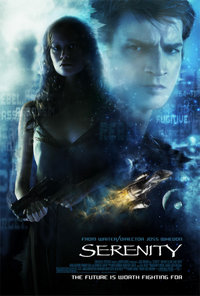
About a year ago I blogged about the sci-fi series Firefly, created by Joss Whedon, better known as the person behind Buffy the Vampire Slayer and Angel. As I mentioned in that posting, a movie version was in production, and it was released to generally positive reviews a few weeks ago. What with one thing and another, we didn’t actually get to see it until tonight, when it was only still showing on one screen in the area. This is indicative of the general reception around the world, where despite the positive reviews, the reciepts have been lacklustre.

To be honest, it is somewhat of a shame, as those people we know who have seen it, have come out having enjoyed it, and wanting to see the series, and even tonight a number of other people in the audience were planning to search out the DVD box set. However the realities of the movie industry are that currently it doesn’t look like it’s going to make much of a profit, with the US takings predicted to be about $28 million, against a budget of $39 million. Whilst both Beth and me would love there to be more movies, or even a new series, on the current takings I’ll be surprised if there is.

Anyway, what did we think of the movie? Having seen so many TV series get messed up when they hit the big screen, we were glad to find that the essential essence of Firefly had been preserved.

The film opened with a flashback sequence of Simon rescuing River, occuring just before the events of the first episode of the series. This then led in to an Alliance operative planning to locate River, having first dispatched the scientists who let her escape, and if you’ve seen the series, failed to recapture her.

From there we cut to Serenity where the crew are getting ready to pull a robbery, however there are some notable absentees from the series – Shepherd Book someone who the series had hinted that there was a lot more about him to learn, and Inara, who as the original series ended had said she was leaving anyway. For fans of the series, both characters did appear later, as we find Book settled on a planet, and Inara returns as the Alliance operative uses her to get to Mal.

I think as fans of the series, we definitely had an advantage in knowing the characters, as there is little chance for backstory. To some extent it feels a bit like the final episode that the series never had, with resolution for a number of plot threads, and moving others along a bit further. Perhaps one of the bigger revalations is the origins of the Reavers, as rather than avoiding them as the crew did in the series, in the movie they have to go search them out!

Having said that, as with other Joss Whedon productions, he’s not afraid to do unexpected things, and although we knew that not all the original crew made it out the other end, it still came as a shock when they went, and at times you really found yourself wondering if any of them were going to make it out at all, and whether this was going to be a Blakes 7 style ending where it all ends in disater.

Firefly - The Complete Series [2003]

I read a letter in SFX magazine this month who said that they thought that Star Wars III was a good sci-fi movie until they saw Serenity. Whilst I haven’t actually ever thought Star Wars III was overly great I certainly wouldn’t disagree with the sentiment that Serenity is a superb film, and highlights what a great difference proper characterisation can make. It is really a massive shame that Star Wars III and not Serenity is the one making all the money, and whilst we have the prospect of a Star Wars TV series, I suspect this movie may have been the last we will see of Serenity. Having said that, maybe the movie will be a big hit on DVD – and certainly it will be interesting to see what the sales of the Firefly – The Complete Series DVD will be like over the next few months. Maybe the crew of Serenity will manage another escape from cancellation – we can but hope.