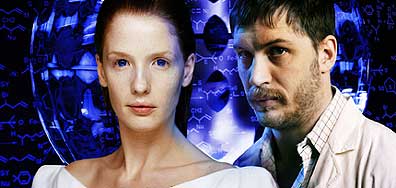
Following on from their remake of Quatermass last year, BBC4 tonight screened a remake of the landmark sci-fi series from 1961, A for Andromeda.
As with the Quatermass Experiment, the original of A for Andromeda is largely gone from the archives, with just one of the original seven forty-five minute episodes remaining in existence. Whilst the new production didn’t follow the 2005 Quatermass live production experiment, it did trim the running time down to a single ninety minute programme – highlighting again how much pacing in TV drama has changed.
The basic plot is largely unchanged from the original. A small team of scientists working on a secret MOD project, in this case to provide computerised listening technology to gather intelligence from telephone calls and e-mails, is as a side project listening to background noise from space. They pick up what seems like a repeating signal coming from Andromeda, and despite the MOD trying to shut down the project, they carry on and decode it. Having decoded it, they discover that it is the plans for a genetic super-computer, far in advance of anything known – at which point the military start getting interested.
They build the computer, and it starts asking questions on biology and genetics, and then even manages to access the internet in order to obtain more information. It then starts giving them instructions to produce cells, piquing the interest of some of the scientists to the possibilities of providing cures for diseases – and making the lead scientist concerned as to whether there is something more sinister. Then one of the scientists is killed in an ‘accident’ having been passed a copy of the message to an American spy, and Christine, another of the scientists is killed when she gets too close to the computer.
Shortly after this the results of the computers genetic instructions is created, a fully grown humanoid that looks exactly like Christine, and is a channel straight to the computer. With the man from the MOD having had the lead scientist locked up, and asking the humanoid – now named Andromeda – to create biological weapons, and the team that had been working on the enzymes to cure disease being struck by a flesh eating virus, things start to look pretty bleak.
All in all I thought this was a better production than Quatermass last year, certainly in terms of the pacing. Indeed, there is certainly the possibility if tonight’s production was a success to stage the follow up, The Andromeda Breakthrough as some of the key plot elements that lead into the sequel were left in place. The story also worked well as a contemporary retelling, indeed it is worth noting that the themes are ones that have been reused a number of times since the original series in both films and books, for example Contact, and Species. Hopefully we can look forward to more of these lost drama’s being re-staged.
A novelisation of the original story are also available – even if most of the series is now gone.

Apparently the recently recovered sixth episode of the original A for Andromeda is now in the hands of the BBC’s restoration wizards, and may get an airing on BBC4.