Visit Asda… and talk about God???

Last Sunday evening, our vicar told us about an experience he had in an Asda store. He walked in – and saw a Greek Orthodox monk, in full robes, with a shopping basket over his arm. He did an (understandable) double-take, and then thought it had to be a student prank, or something of the sort. So he went up to the guy to talk to him, and got as far as ‘Are you really…’ before noticing his badge which said ‘Asda’s Official Chaplain’. The monk said, ‘Yes, I am really”, and they had a conversation about what he does and why Asda feels that having a chaplain in-store is a good idea. Apparently, he has several people come up to talk to him about their problems, their life stories, or just wanting to know why he was there. And the Rev also talked to a few other store employees, who said that their chaplain was amazing, and that he showed others a lot about the love of God.

I find this intriguing. At first thought, chaplains in a supermarket seems a pretty daft idea. Yet, a vast number of people say that they don’t have time to go to church, to make a weekly commitment to meeting with other Christians (or people of a similar faith) and to worship with them. And many other people are searching for something to believe in, yet feel intimidated by the idea of calling up a priest or vicar, or visiting a church to ask questions or get some answers. So, why not chaplains in places where people visit on a regular basis? And this particular Asda is not unique. There’s the Bishop of Asda in Manchester, and an Asda store in Elgin appointed a chaplain in 2003. Doing a ‘google’ seems to turn up all sorts of chaplains in all sorts of places – Sainsbury’s, too.

Well, if the people aren’t coming to church, why not take the church to the people?? Sounds like a a few loaves and fishes might be on offer, too… 😉
Eurovision

So it’s that time of year again, time for the annual review of who likes who in Europe, thinly disguised as a song contest, which takes place in Kiev tomorrow night. Apparently, other parts of Europe take the whole contest, started to promote European harmony and song writing, very seriously. However in the UK it is viewed as a combination of camp entertainment and a musical train wreck thanks in no small part to the commentary provided by Terry Wogan for the BBC.

Eurovision Logo

There has already been one bit of shock news, with Ireland being booted out at the semi-final stage – a far cry from their run of wins a few years back where it almost got to the point that they couldn’t afford to host the competition for another year! Of course, as the British stump up a lot of the cash to stage the competition, we automatically get through to the final, however badly our song does each year.

The marathon show splits into two parts. In the first part the 24 countries (14 who either scored well enough last year, or like the UK provide a lot of the cash to run the competition, and 10 who qualified from the semi-final on Thursday) out of the original 39 will each play their song. In between each song, the host country, this year Ukraine – who won the previous years competition – gets a chance to show a series of brief films highlighting aspects of the country. After the songs, there is an interval act, that is sometimes more memorable than the songs (remember Riverdance? Bet you can’t remember the song that won in that year though!), which gives everybody in the 39 participating countries a chance to vote by phone.

After that comes perhaps the most bizarre part of the whole affair, when one by one, each country gives marks from 1 to 12 points, based on the top ten songs in the results of their phone vote. This method of course gives small countries such as Malta equal voting power to populous countries such as Russia. It is also the point where you get the impression that there is something very strange going on. Greece and Cyprus will always give each other top marks. All the Baltic countries vote for each other, as do all the parts of the former Yugoslavia. All the former Soviet republics always give Russia a big vote. The UK always tends to place Ireland pretty highly, but our points are very dependant on how popular we are in Europe at the time. For example when Tony Blair was elected in 1997, we won. However after a number of years of the UK making itself unpopular, when the UK joined the USA in invading Iraq, we got “nil-point”. (It is worth saying that in that year we also had a singer who started in a different key from the backing track, so we didn’t even pick up one or two votes as we usually do). As our entry last year has said “The results are not important, as long as you don’t end up with zero“.

If you’re really interested, the Wikipedia has an extensive section on the contest, including the bizarre voting patterns, and the other rules and regulations – plus it also has the results of every single contest since the first in 1956.

Current favourite looks to be Greece. However as is usual the bookies will have got it totally wrong, and Terry Wogan will be left amazed at the voting!

Store Wars

As has happened previously with the arrival of a new Star Wars film there is an upsurge in related spoofs, sketches and so on.

I found this one, Store Wars thanks to Ian over at Youthblog.

Store Wars

It is essentially a promotion for buying organic produce, however it is pretty funny, and is a demonstration on how many vegetable jokes you can fit into a short sequence – the most funny being towards the end in a version of the famous “I’m your father Luke” scene.

Galloway against the US Senate

Perhaps one of the more entertaining items on TV last night, was coverage of George Galloway’s appearance before the US Senate investigation into corruption in the UN oil-for-food programme.

Galloway senate

Whilst Galloway is well known in the UK, being one of the more memorable characters in British politics, he is pretty well unknown in the USA. He was previously a Labour MP in Glasgow, but following on from his two visits to Iraq during the period between the two Gulf War’s, where he attempted to highlight that sanctions only affected the Iraqi people, he vocally opposed the attack on Iraq and was thrown out of the party. He then set up his own party, and stood at the recent election in Bethnal Green, and beat the sitting Labour MP.

Although I don’t share his far-left politics, I do tend to find that he livens up British politics, and in some ways I was quite glad that he got back into parliament. It is fair to say he is vocally anti-war, and very forceful in his opinion. If the senate were expecting a quiet, intimidated, apologetic Galloway, they were sadly mistaken. What they got was Galloway attacking them “with both barrels”, in what the BBC has described as an “Explosive Showdown“. The US press were fascinated, some channels covering the whole appearance live. In fact the reaction of the US press has also been highlighted by the BBC.

To be honest, I doubt much progress was made in terms of the investigation, but the appearance certainly produced some good quotes:

“Who paid me hundreds of thousands of dollars? The answer to that is nobody and if you had anybody who paid me a penny you would have produced them here today.”

“I have met Saddam Hussein exactly the same number of times as Donald Rumsfeld met him. The difference is that Donald Rumsfeld met him to sell him guns and to give him maps the better to target those guns.”

“Senator [Coleman], in everything I said about Iraq I turned out to be right and you turned out to be wrong and 100,000 have paid with their lives, 1,600 of them American soldiers sent to their deaths on a pack of lies.”

The interesting end to the session was when Senator Coleman said to the press that he didn’t think Mr Galloway had been a “credible witness”, and that if it was found he had lied under oath, there would be “consequences”. It is interesting to note that the last time someone tried to prove that Galloway had recieved money from Iraq, they lost in court… Round two of Galloway against the Senate, if it happens, might be interesting!

Shock Horror – The British Debate The Weather

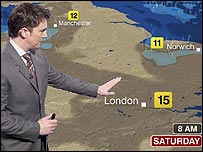
Not content with talking about the actual weather, the debate today has been over the new style BBC weather forecasts.

Old style New style

Several times during the day BBC presenters have turned up explaining the new style forecasts in the face of a majority of people who don’t like the new style forecasts. The broad issues are as follows:

  • The UK is coloured brown not green.
  • The new perspective view makes the south look a lot bigger than the north.
  • The flying over the UK effect seems to give some people motion sickness.
  • Where are the distinctive BBC symbols?
  • The counter arguments I’ve heard so far are as follows:

  • Brown makes it easier for people to distinguish the cloud shading.
  • Yes it does(!)
  • We don’t do it as fast as we could…
  • Because of their size in relation to the map, the old symbols are inaccurate.
  • I have to say, after the first day, I do rather agree with all of the objections. Whilst I accept that the new style is more accurate, with the lack of many places on the main map, I still can’t totally accurately place myself on the map, so accurately knowing the weather at a particular spot is pointless if I don’t know to the same accuracy where that spot is located. As to distinguishing browns, I also have difficulty spotting the fairly subtle variations in brown shades for the cloud cover, and a similar, although lesser problem with the blues for rain. Obviously they had a focus group with 20-20 vision and a big TV screen!

    However, one interesting discovery I found, was in the online service, which uses the same software, complete with the familiar top down map, and the familiar symbols. It does stink a bit of kids with their new toys, so maybe in the coming weeks we’ll see the familiar symbols reappear, I hope so, at least then I’ll be able to work out the weather from the TV forecasts.

    Update: The debate has even reached Westminster! Today the MP for the Western Isles in Scotland put down a motion calling for the BBC to reconsider a map that gives a distorted view of Scotland. In addition the BBC has had 248 calls about the new weather – only 8 in favour. One is really tempted to ask quite who they consulted for their audience research.