F50fd First Attempt

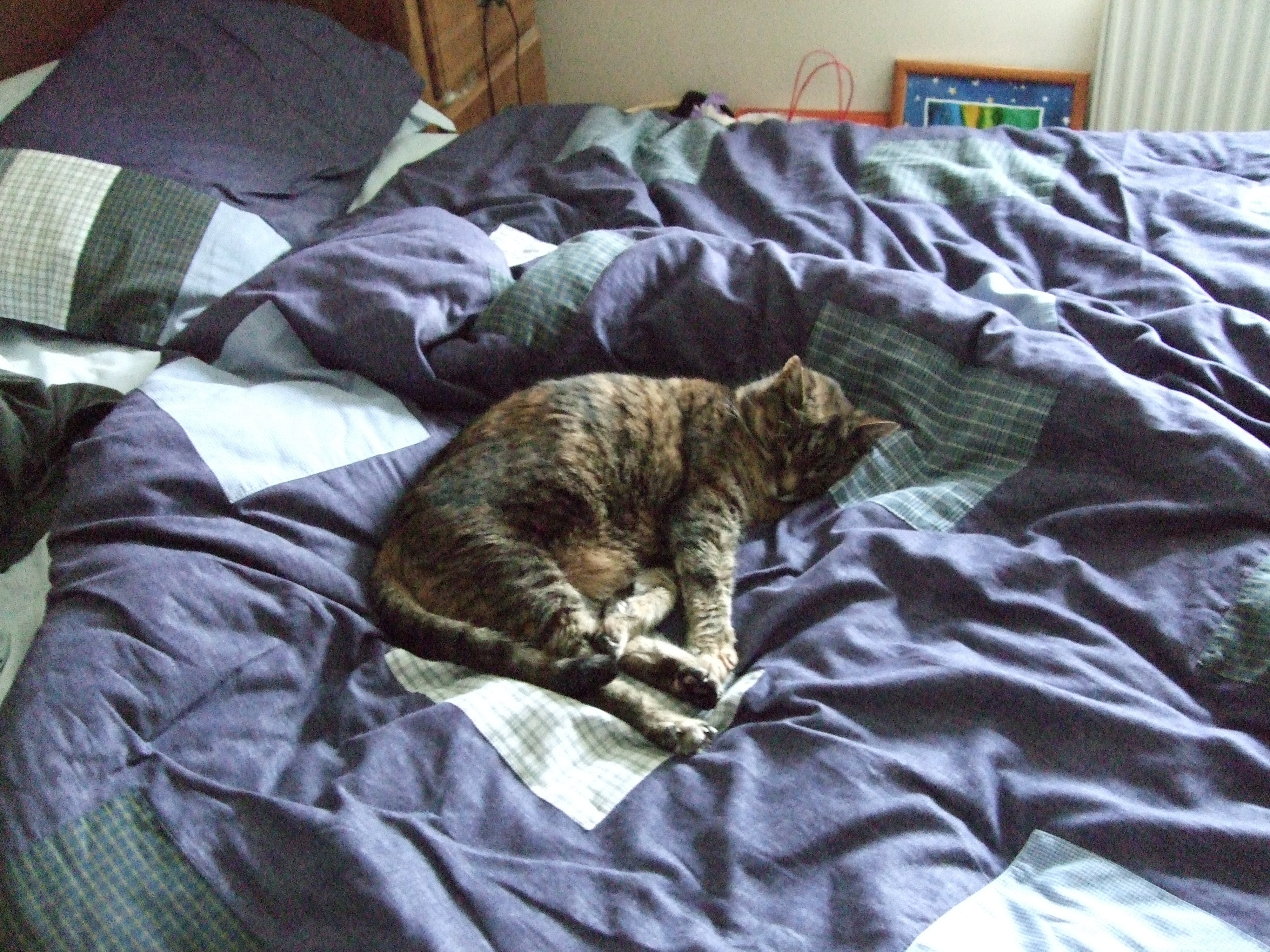
Sophie Asleep

Okay, I know it’s totally predictable – one of the first pictures I take with any new camera is one of Sophie…

Having said that, she is actually quite a good test as with the multitude of different colours in her coat it usually shows up pretty quickly any issues. This time the picture is of Sophie asleep on our bed, taken using the natural light mode of the camera, and with very little of that. Although the image stabiliser is on, the other thing the camera has done is bumped the ISO setting up to 1600, which pretty well immediately shows up one of the issues with the camera, and one of the main criticisms I’ve seen of it – the noise you get in high ISO images.

It doesn’t look too bad at the size on this page, but if you take a look at the original size you can clearly see how noisy the image actually is. It is something that can be cleaned up with a bit of work in Photoshop, especially with specialist plug-ins like Neat Image, and also being aware of it you can configure the camera accordingly – it’s just going to be snapshots like this one where it comes up. As with any camera, it’s all a question of getting used to it’s particular peculiarities, strengths and weaknesses.

Flickr Loves You – A Lot…

Apologies to anybody on my Facebook friends list if you turn up in any pictures I have on Flickr – I’ve come across a new Facebook/Flickr application called Flickr Loves You that provides much better Facebook integration than my previous choice zuPort: Flickr, specifically it provides the people tagging feature that regular Facebook pictures support.

I had a good go at trying out the tagging feature last night, as anyone who happens to turn up in my pictures on Flickr a lot – and as with regular Facebook pictures it notifies you that I’ve tagged you – apparently every time I do it. So for everybody involved in the Bakinghammer Wedding, you’ll be pleased to hear I’ve done that batch of pictures…

A Lucky Escape

When I first heard the details of the plane crash at Heathrow yesterday, my first thought was quite what a lucky escape everybody had. The flight was coming in from the east, so would have done the traditional run over central and west London known to so many people – indeed news reports last night were showing this YouTube video of the same approach, on the same kind of plane, to the same runway – which does go to show you quite how populated the areas under the approach actually are. The pilot yesterday managed to get the plane across the perimeter road, and although he hit the ground before the runway, it was within the airfield.

However, the big question now is what went wrong. Reports are saying that the pilot had told an airport worker that all the electronics had failed, and he had lost all power. That would have left the pilot with nothing but the emergency manual backup to the fully fly-by-wire systems to bring the plane in.

It also reminded me of comments that I heard from someone who worked for British Airways on aircraft maintenance for many years, finishing his career working on the 777 fleet, bemoaning the differences with the modern planes. On the older planes the mechanics that keep the whole thing going are fairly straightforward – there is a mechanical link between the pilots controls and the fundamental components that keep the plane in the air. With modern planes such as the 777, the links are electronic – essentially the pilot controls a computer which then controls the fundamental components, and the computer is essentially a black box. Fixing a fault involves removing one black box and putting in another – as he said, you can’t visually check the fundamentals, and you are essentially trusting in the skill of the electronics specialists that what is inside the black box does what it says.

Whilst it could be some sort of power system fault, some component having been improperly replaced, I really wouldn’t want to be a software engineer working at Boeing over the next few days. It definitely makes me glad that the bugs in my software are not a life or death situation like this…

heathrow plane crash 3 originally uploaded by artofthestate.

Can iTunes Rentals Bring iPlayer Downloads to the Mac?

One of the biggest criticisms of the BBC iPlayer has been that the download service is Windows only – and limited to specific versions at that – ruling out licence payers using other platforms such as the Mac. Indeed I’ve blogged previously about the pressure that the BBC is under by the BBC Trust to get such a cross-platform solution.

The basic problem has always been that there wasn’t a solution that met the requirements – the ability to have programmes downloadable, but then only able to be watched for a week after the original showing, but was cross-platform. Windows Media DRM provided the functionality, but not the cross-platform support.

That all changed this week, with the Macworld Keynote. As part of that, Apple announced iTunes Movie Rentals. Although the lengths of time are different, the fundamental principle that the BBC required, that the programmes only be able to be watched for a limited period are there. When I was watching the keynote, the thought did cross my mind as to whether we’d find the BBC amongst the big film studios come the UK launch.

It hasn’t taken long for the BBC to start making positive noises, with Ashley Highfield, the director of Future Media and Technology stating on a BBC blog:

The announcement from Macworld about the effective relaunch of the AppleTV (Jobs: “we tried with AppleTV, but its not what people wanted. So we’re back with AppleTV take two – no computer is required”) is encouraging.

This, coupled with Apple’s (long anticipated) move to a rental model, means that we can look to getting BBC iPlayer onto this platform too, as we should be able to use the rental functionality to allow our programmes to be downloaded, free, but retained for a time window, and then erased, as our rightsholders currently insist.

Whilst it won’t reach Linux users, using iTunes would reach more users than the current solution – more than that, the programmes would be transferable from a computer, to an iPod, and could even be watched back on a TV using the Apple TV – giving an option for people without a suitable computer at all.

I also can’t imagine that Steve Jobs isn’t going to jump at this – just think of the media coverage if the BBC boots out a Microsoft based solution in favour of iTunes

Methodists Launch a Credit Card

lentcard.gif

The daily e-mail from Ekklesia made me sit up and take notice this morning – the Methodist Church in the UK is launching a credit card

This seemed somewhat ironic considering the discussion I was having with a Christian friend yesterday about her feelings now that she didn’t work in the finance industry, as she had always felt uncomfortable with some of the things that went on. For example something I’ve fallen foul of, processing all the debits against an account before the credits, which of course generates an overdrawn charge if money in the account is tight, or the brewing concerns over mis-sold home loans – as she said, the industry seems to make most of it’s money from those who can least afford to pay. I can think of numerous other examples from my own experience, for example energy companies who charge those using key meters – generally those on low incomes – more than those on regular meters. Just reading the headline, the question of whether a Church should be getting involved in the finance industry is definitely foremost…

Of course, the Methodist Church isn’t getting into the finance business, as the card won’t allow you to spend any money at all. The launch is part of their Lent campaign, which is aiming to get people to consider before they spend, looking to address the soaring levels of consumer debt in the UK, and refocus participants in the campaign as to their priorities. The idea of the ‘credit card’ is that participants will keep it in their wallet, and be reminded whenever they reach for one of their real cards, and maybe think twice about whether they really need what they are about to buy. The concerns about consumer debt aren’t just restricted to the Methodist Church – the Church of England has recently added an entire new section to their website dealing with the same issue.

The Methodist Church are keen to point out that this isn’t about not spending anything:

“When we take time to think about the things we buy and why we buy them, it can help us to reconsider our priorities. I may well want to buy something, but does that mean that I need it?”

“However, Buy Less: Live More isn’t about depriving yourself of those things you want; it’s about looking at life in a new way, trying different things and taking a few risks. So as well as reducing your carbon footprint by getting off the consumer treadmill, you can live life in all its fullness.”

Alongside the card itself, participants can sign up to an e-mail list that will issue daily ‘Buy Less’ and ‘Live More’ challenges, along with a dedicated Facebook group to support the campaign.