Tag Archives: MacOS X

Windows Vista – First Experiences

So this afternoon I decided to give Windows Vista a go, to be more precise, Windows Vista x64…

After a bit of messing around with Partition Magic, and some deleting of installed software I managed to clear enough space for a new partition, with just enough space for an install, but not much else. Since I have a backup of the machine anyway, and the machine is not my main computer, I decided to get the full experience I should just go the whole hog and install onto the main partition – after all there is not much point in having the OS installed if I have no space to install software!

So I set the installation going. Helpfully it detected my current Windows XP install, and moved it to a folder called Windows.old. Upgrading wasn’t an option since as a quick look at the upgrade matrix published back in July my existing XP64 installation won’t upgrade.

Now I guess this is proof that I’ve been in MacOS X too long, as something like this isn’t usually a problem, as the recommended way to upgrade MacOS X is to do a clean install, and then use the migration assistant described in detail over at Mac Dev Center.com to pull all the relevant settings and applications out of the backed up folders.

Now I’m aware that the PC equivalent can’t do applications, but it seems that even though the install creates the Windows.old folders, it can’t cope with pulling settings from it – it only works with another machine.

Ok, not too much of a problem, I can just mount up my backup image in a virtual machine using something like Virtual PC or Virtual Server – but no, neither of these can run under Vista. In much the same way as with the various editions of Visual Studio (even Visual Studio 2005 – their current version), they don’t work, the best option is to run a beta version of the upcoming release.

Having said that, it’s not all bad news. The driver support in the 64-bit Vista is better than XP64. All but the sound driver and the wireless networking installed off the installation DVD. The sound driver the OS found online, and it was only the wireless networking that had me rummaging around on the internet.

It does look rather pretty too, with some font changes, and various bits of MacOS X-ish eye candy. As with Office 2007 if you scratch at the new paint job a bit, you can quickly find bits of classic windows peeking through. Quite often if you click through some of the nice user friendly screens, or go for an advanced option you find a decidedly familiar window popping up, scarcely changed from Windows XP.

The new security features are rather amusing at the moment, but I suspect will become rather annoying. As Coding Horror highlights, referring to an original article by Paul Thurrott, Microsoft have opted for their traditional security through warning dialogs – as in a number of previous products, when something happens that could be potentially risky, it displays a warning, with the option to allow, or cancel what is happening. However it rarely gives much detail about what is going on, and pressing allow will allow it to carry on. Ok but these dialogs come up so frequently, even for really basic tasks, that I am sure most people will just ignore them. Bear in mind that I’m running as an Administrator currently – if I were a normal user it would be asking for passwords all the time. The other security feature that had my jaw on the floor was when I tried to delete an empty, but protected folder on my hard drive. Vista correctly informed me that the folder belonged to another user, and was protected. However it then offered to unprotect it for me. Without asking for a password or anything, it took ownership of the folder, changed the access rights and deleted it! True you can turn this off – but it somewhat defeats the object, and if it’s off, the machine keeps complaining about the fact too. Hopefully I can try and find some happy medium between the annoyance of totally on, and the complaining of totally off, but I doubt it.

So will Vista have me switching back full time to a PC – not a chance. On a positive note it is better than XP, but still it is not a patch on MacOS X, and that is even before we see Leopard…

Update: Ironically, and totally coincidentally it seems Dave Oliver has been giving Vista a try too. The big difference is that he’s using Vista 32 – where the upgrade advisor works (on 64-bit it suggests running it, and takes you to the download page. It’s only when you download the thing that it says it won’t work on 64-bit operating systems.) It seems he’s had many more driver issues than me, significantly that it failed to recognise his graphics card.

I’m currently seeing how various games run under Vista – annoyingly the security features are coming in to play and the OS is asking again for permission when I insert every new CD of a multi-CD installation, despite it being the one installer running the whole process.

Proof that Americans Don’t Get Sarcasm?

David Pogue did a very funny, and very sarcastic video on Windows Vista where he attempts to prove that the new Microsoft operating system isn’t just a rip off of a load of ideas in MacOS X. What is even more funny, is that according to his blog he has had complaints from people that some of his differences aren’t really different…

Memory Upgrade

iMac G5 Opened Up

So I’ve finally got around to upgrading the memory in our iMac G5. Back when we got our first Mac, it was recommended as pretty well the first purchase for the machine. At that time, Apple shipped their consumer machines with a paltry 256Mb of memory on board, so it was pretty well essential to avoid a lot of waiting around. When we got this machine, they were shipping with 512Mb of memory, which is pretty much adequate, and it only really causesproblems when we you try to multi-task a lot of applications, or load something big.

Unfortunately, as time has gone on and our iPhoto collection has grown, and our iTunes database has expanded, loading either application tended to result in a large lump of the active memory disappearing, and then a good deal of disk activity as the operating system starts swapping memory off to disk, so I decided that it was about time I upgraded. MacOS X, like Windows XP likes as much memory as it can get.

Anyway, I pointed my browser at Crucial Technology, and stepped through their useful Memory Advisor tool that makes sure you get the right memory modules. The iMac has two memory slots, each of which can take up to 1Gb, and ships with a single 512Mb module in one slot. Although it is quite happy to take different types of module in each slot, it runs better with a matched pair, so after some going back and forth, I decided to go the whole hog and get the full 2Gb upgrade. My figuring is that iPhoto and iTunes are only going to get larger, so whilst 1Gb may be adequate for now, we may as well do it in one step, and then there is only one redundant module rather than two.

The upgrade turned up in the post yesterday, and I grabbed a copy of the Apple Upgrade instructions. Because of the compact design, the upgrade is a bit more involved than the equivalent upgrade for an eMac. To do the job on an iMac G5 you have to loosen three screws, and flip open the entire back of the machine, giving a good view of the whole of the innards of the machine, including the processor, the hard drive and the motherboard. The memory slots are pretty obvious and easy to get to, and the actual process of putting in the new memory is pretty quick. The only slightly complicated bit is ensuring that the clips at the top of the back slot back into place.

Having said that, it’s made a big difference to the performance, especially with iPhoto which comes up noticeably quicker. My thought is that with the lower amount of memory iPhoto is loading and almost immediately swapping memory out to the disk, resulting in a good deal of the disk access. Certainly it will be interesting to see what else runs faster, but if you’ve got a Mac with 512Mb memory I can certainly recommend beefing it up a bit.

PC Pro Schizophrenic Over Apple?

I’ve commented before over the changing attitude of PCPro to the Mac. Since then, the MacBook has even turned up, and done relatively well in a comparison of budget laptops in the magazine. However in the November issue, that turned up in the post this morning, they are getting increasingly schizophrenic. Of course this is quite obviously because they give their columnists a large degree of editorial freedom, but it still makes interesting reading.

Leafing through the new magazine, the first indication was a big two page advert for the MacBook, with the black version on one page, and the white version on the other. It is a typical Apple minimalist creation compared to most PC adverts, in that it doesn’t have masses of machine specs, nor does it even have a prominent Apple logo. In the past you’d occasionally find adverts for Apple products like the iPod, but I have rarely seen adverts for the computers in PC magazines, perhaps it is an indication that Apple is looking more seriously at going after PC owners as a potential market.

The next thing I came across was an opinion piece by Ross Burridge, the magazines reviews editor. Now if bits of this had turned up in a Mac magazine, I would have regarded it as sarcasm, but as it is in a PC magazine, I’m sure he is quite serious. The point of the article was to counter the complaint that Microsoft hasn’t really done much with Windows XP. It is a familiar practice to look at the Windows platform, highlighting that the last major OS release was Windows XP back in 2001, and then compare this with the multiple OS releases that Apple have released over the same period. Not surprisingly he turns this argument around, pointing out that there have other versions of Windows XP released in the intervening period, for example the various tablet and media centre editions. He compares this with the ‘nominally improved’ versions of MacOS X that have been released over the same period. Whilst you could argue that only nominal improvements were needed because the original was pretty good anyway, his statement is incorrect. The version of MacOS X that was around when Windows XP was first released was version 10.1, Puma which was regarded by many as not being stable enough to use as a main operating system, and missing a number of key features. Indeed at that time, Apple were still shipping Macs with MacOS 9 as boot up default. Certainly I’d challenge anybody to compare Puma with a current version of MacOS X and only find nominal improvements. Finally he caps it off by quoting £400 as the amount that a Mac user will have spent on upgrades over the same period which is also somewhat of an exaggeration. True the more frequent big number upgrades will cost more in the long run, but £400 certainly seems like he’s including iLife upgrades too, something which the same magazine said wasn’t part of the OS for the purposes of their comparison article. Oh and he also uses the classic argument that Windows is safer because it has lots of anti-virus software, making it safer if some mythical really bad MacOS X virus comes along.

However the schizophrenia really kicks in when you get to the Jon Honeyball Advanced Windows column. He quite frequently mentions his Apple machines in the column anyway, but this month he starts off talking about his visit to the Apple Worldwide Developers Conference, where he was asking questions about the upcoming version of MacOS X, Leopard. The two features he particularly picks on are Time Machine and the updated Spotlight. With Time Machine he raises concerns over the frequency of full backups as opposed to incremental backups, something that is controllable through the backup software included with Vista, however he concludes that because Time Machine is so well integrated into the OS, whilst the Vista backup solution is hidden away (backup software is not even installed as part of an XP Home install, you have to manually install it from the CD) and so is unlikely to be used by an average home user. Moving on to Spotlight he focuses in on the new network search functionality, and concludes that it will be unlikely to scale well, however for the home market with a small network of machines it is fine. He then uses this as a starting point to compare the attitudes of Apple and Microsoft to the home/SoHo user. Interesting points he makes are that Apple have a straightforward policy whereby everybody gets the same version, whilst Microsoft have an array of options, with some features missing from the cheaper versions. Indeed he quotes one of his friends as saying that the Microsoft attitude is to “make it so complicated that hopefully they’ll all buy the most expensive version out of fearâ€?. Ultimately he concludes that the battle for the home market is about to heat up again, and that in his opinion the wining product is not the one from Microsoft, indeed he even goes so far as to highlight that he is advising home users to upgrade to Apple machines – something that is quite a surprise from an Advanced Windows column!

So can we expect PC Pro to become a Mac magazine any time soon? I doubt it – PC Pro has a primary focus on business computing. However, if Jon Honeyball’s predictions about who will win the home market come true, it will certainly be interesting to see how the magazine changes…

How Serious are Apple about Windows XP on a Mac?

Back in January, you may remember that Howard bought himself one of the first Intel Macs, you may also remember how he was a definite early adopter with Windows on the Mac, but then hit a number of problems with the limited driver support offered by Boot Camp. Anyway, chatting with Howard today he was talking about his new Dell laptop. Essentially, Apple has not updated the drivers that Boot Camp uses since the original release, so all the same problems remain.

That set me thinking, is it really a pipe-dream that Apple will ever provide drivers that will get the best out of Windows running on a Mac?

Thinking about it, it doesn’t really seem to be in Apples interest to get Windows to perform well on their machines. Since many of their revenue streams are tied up with MacOS X and it’s applications, if users buy their hardware and then just install Windows, Apple won’t make any more money from them. Certainly it seems to make more sense that there will remain key missing features and niggles with the Boot Camp drivers, and generally poorer performance that you’d expect, so that there remains a reason to boot up MacOS X on the machine.

Essentially, several months down the line, the Boot Camp episode was much more about publicity, and putting a stop to the third party hacker efforts to boot Windows, as providing users a fully working version of Windows on Mac hardware. Indeed, I wouldn’t be at all surprised if Boot Camp changes into something a lot closer to Parallels Workstation where Windows has to run within MacOS X, again giving a reason why MacOS X has to be booted up. Certainly, it doesn’t really make a massive amount of sense to waste too much time and resources on a project that reduces the long-term revenue they could earn.

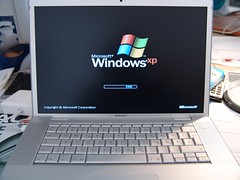
Mac running XP picture originally uploaded by alienx.