Category Archives: Politics

Postings related to elections and general political stuff

Peace Loving Christians?

Talking to Mum today on the phone she was talking about her most recent “In Good Faith� article for the local paper, and the reaction to it in the letters page. The responsibility for the column alternates between a number of people in the local area, and Mum has contributed for a number of years, and it has to be said that it is not unknown for her columns to merit a reaction in the letters page!

Her column this time around was written about Remembrance Sunday, and more specifically the use of the National Anthem on that occasion. In terms of Church use, aside from significant occasions it is about the only time it gets used in a Church context. In light of the media debate over the red or white poppy this year she talked about the choice of verses for our National Anthem, particularly the ‘modern’ politically correct version that gets used in many places today.

Whilst in many situations, only the first verse of our National Anthem gets used, there are a number of official additional verses, and over the years been a number of additional verses added – at one point reaching eight verses. Depending on the age of the hymn books in use in the Church, there are still a variety of different versions of the words in use. Our older hymn book, the 1983 revision of ‘Hymns Ancient and Modern’ includes two versions of the anthem, one with the traditional three verses, and the other with two verses, the second being the one often considered the ‘modern’ verse. It should be noted that the second verse is also indicated as one that could be omitted. Our newer hymn book, ‘Hymns Old and New’ combines the two versions in ‘Hymns Ancient and Modern’, removing the second traditional verse, and adding the ‘modern’ verse to the end. I’ll list the words to the traditional version and the our newest one below. Firstly the traditional:

God save our gracious Queen,
Long live our noble Queen,
God save the Queen:
Send her victorious,
Happy and glorious,
Long to reign over us:
God save the Queen.

O Lord, our God, arise,
Scatter her enemies,
And make them fall.
Confound their politics,
Frustrate their knavish tricks,
On Thee our hopes we fix,
God save us all.

Thy choicest gifts in store,
On her be pleased to pour;
Long may she reign:
May she defend our laws,
And ever give us cause
To sing with heart and voice
God save the Queen

Now the one from our newer hymn book that we used this Remembrance Sunday:

God save our gracious Queen,
Long live our noble Queen,
God save the Queen:
Send her victorious,
Happy and glorious,
Long to reign over us:
God save the Queen.

Thy choicest gifts in store,
On her be pleased to pour;
Long may she reign:
May she defend our laws,
And ever give us cause
To sing with heart and voice
God save the Queen

Nor on this land alone,
But be God’s mercies known
From shore to shore:
Lord make the nations see
That men should brothers be,
And form one family
The wide world o’er

The point of Mum’s column was to highlight that although the additional verse is often seen as a modern addition linked with a modern change in attitude amongst Christians towards war, it is actually much older, indeed the additional verse is actually one of four alternative verses written by William Edward Hickson in 1836, as part of a debate over the words of the anthem at that time when particularly the second verse was considered offensive. More of this version was used in the English Hymnal, the hymn book used at Church when I was growing up. Indeed when you see the other verses that had already been dropped you can see that the second verse is fairly restrained, take verse six (with apologies to any Scottish readers), written as a result of defeat at the Battle of Prestonpans in 1745:

Lord grant that Marshal Wade
May by thy mighty aid
Victory bring.
May he sedition hush,
And like a torrent rush,
Rebellious Scots to crush.
God save the Queen!

In terms of the reaction to her column, the paper published a letter it had received quoting the omitted second verse, and commenting that it wasn’t very peace loving. Needless to say Mum is slightly frustrated as the whole point of the column was to point out that Churches often dropped that verse, and replaced it with the Hickson verse because of the sentiments expressed!

Having said that, although the Hickson version is more than a century old, and certainly to many modern Christians the holy war as a Christian concept is something that occurred back with the Crusades, the publishing of the next in our series of Finchampstead Parish Magazine Extracts, with extracts from the magazines during the First World War, paints a slightly different picture. The booklets reprint selected items from the Church published magazine, now published by members of the village, and whilst there are a lot of similarities with what our modern parish newsletter publishes (an earlier booklet has a 19th Century item about the activities of the Sunday School that is remarkably similar to what happens today), the war extracts are most striking, especially in the editorial undertones, take this item from June 1915:

“Are there not still, however, a fair number of unmarried men in the parish who ought to feel that their right place is with those gallant men who are so nobly upholding the great traditions o our race and whose praise is being so loudly sounded throughout the Empire?�

Whist it’s not explicitly putting it as a God given command, being written in something produced by the Parish Church it would be a big surprise, and probably controversial if we were to write something similar in a Church publication today. How Christians react to War and particularly Remembrance Sunday, has always been a difficult and thorny area. For example whilst there are still military chaplains, Christians in the military, and we still call on God to protect our ships when they launch, the White Poppy that caused controversy this year has been around since 1933, and was created by a clergyman as part of the Peace Pledge Union in reaction to a sermon by a former Army Chaplain on Amistice Day 1933:

“If I blame anybody…it is men like myself who ought to have known better. We went out to the army and explained to these valiant men what a resplendent future they were preparing for their children by their heroic sacrifices.� He went on to “renounce war because of what it does to our own men� and “what it compels us to do to our enemies�. “I renounce war for its consequences, for the lies it lives on and propagates, for the undying hatred it arouses, for the dictatorships it puts in the place of democracy, for the starvation that strikes after it.�

However, even though we used the more acceptable National Anthem, and the sermon was focused on the horrors of war, there were only red poppies in evidence at our Church, and a number of regular parishioners, and also people who rarely attend arrived wearing their medals. The main street through the village is also closed for a well attended parade to the War Memorial. Certainly, cancelling the Remembrance Sunday parade, or combining it with a regular service as has occurred elsewhere would prove massively controversial. The question is though is quite what proportion of the regular congregation would confess to feeling more in common with the ideals of the White Poppy campaign?

A history of the White Poppy campaign can be found here, and a short biography of Canon Dick Sheppard who founded the Peace Pledge Union can be found here. The Red Poppy campaign can be found here, with more details here.

Welcome to America – Now Take off your Shoes

Last night I got back from my flying visit to the United States, and my first experience of the latest level of security measures.

Ever since the US decided to introduce a security system that allowed their staff to search checked baggage meaning that the baggage has to be left unlocked I’ve not been keen on putting any checked baggage through – quite apart from the baggage security issues (see here, here, here, here and here for examples) the checks will sometimes result in the baggage not actually making it onto an onward flight. As a result I did this trip entirely with hand baggage – having said that it did mean that I came under the new liquid rules.

What is interesting is the rules are not consistent, so for example on my trip over my hand baggage was searched twice, once in the UK, and again when I had cleared customs at Washington and was changing over to a domestic flight. Heathrow was relatively straightforward in that aside from having to take out the plastic bag containing any liquids (all in containers under 100ml) security was much the same as usual. At Washington they additionally required the liquids to go through the x-ray totally separately, and that everybody take off their shoes. (It is worth mentioning that a man sat next to me on the plane back said that when he had gone out through Heathrow everybody had been putting through their shoes.) Hand baggage was strictly limited to one item only. Coming back was different, my hand baggage was checked once at Altanta, and not at all at Washington. People were allowed to carry on one piece of hand baggage plus a ‘personal item’ which could be a briefcase. The sharp objects rules were also apparently not as tight going back, as there were a couple of people on our plane knitting for most of the flight.

There are also a selection of other new rules that I hadn’t come across before, for example passengers are not allowed to congregate around the toilets. The other new one is that the TSA in the US has decreed that passengers should remain in their own cabin during the flight – and that includes the toilets. On the 767 I flew on this produces an odd situation where the block of toilets halfway down the plane is allocated to the business cabin, so the economy passengers sat right next to them have to walk all the way to the toilets at the back. Indeed a pensioner on our flight back, who was sat at the front of the economy cabin and a person travelling with him had a quite heated debate with the cabin staff over why he couldn’t go into the toilet. Quite what the purpose of the rule is I don’t know – I can’t think that someone serious about hijacking a plane is seriously going to be stopped by not being allowed to go into another cabin.

Having said that, the impression I get is that the security measures are there as much to try and reassure passengers over security, rather than actually make flying any more secure in reality. This was actually a discussion I had with a US based colleague, who was bemoaning the fact that people of the future will have an airport system very different from the one he grew up with, and than in reality it probably wouldn’t be that much safer anyway. If you have a read of this Register article which I’ve previously mentioned the liquid threat has more to do with Hollywood than reality – something that is largely true for a number of the previous threats – but somebody serious even within the current rules is still able to bring enough on a flight to destroy it if they wanted. However when you look at the description you realise that to ban the items they would need would be too much of a disruption.

By the end of that article I’d pretty well come to the conclusion that the only real way to be safe as a passengers in the air is not to fly on a commercial jet at all. Of course for most people whilst train is a possibility in Europe, or driving, flying is still safer than the car, and nothing beats it for speed. For going to North America there is really no alternative, so I suspect for the foreseeable future we’ll have a regular cycle of security threat, followed by massive tightening of security, and people will put up with it. Of course for those who can afford it, the private jet industry is probably rubbing their hands with glee…

The Revenge of Ned Flanders?

222px-c-flanders.png

This morning I listened to A Point of View on Radio 4, which today was Tim Egan talking about this weeks spectacular election results for the Democrats in the US mid-term elections. Part way through the programme he described the election as being ‘The Revenge of Ned Flanders‘, which I thought was an interesting description.

Like a lot of people outside the US, I was quite amazed that Bush was returned two years ago, which I think is a lot to do with how Bush is seen in the rest of the world, compared to how he was seen at that time by Americans. Egan highlights how Bush won re-election two years ago – the Republicans managed to mobilise a large group of mostly conservative Christians, who wouldn’t usually have voted, using the issue of moral values. This time around it was exactly the same issue that caused Bush to loose – indeed the issue came ahead of the war in Iraq as the number one issue. Since 2004 there have been a number of high profile news stories highlighting corrupt politicians. More than that, Reverend Ted Haggard, a well known Christian with a hotline to the White House – head of the National Association of Evangelicals, and widely credited with mobilising the Christian vote – had a rather spectacular fall from grace just days before the election. Essentially by courting the Christian vote as they did, the Republicans had set themselves up as a party of superior morality. Ted Haggard had previous said that if the evangelicals vote, they determine the election, which they did – both times. Having set themselves up as the party of morality, in barely two years the voters had discovered that they weren’t as superior as they were saying, and this was the backlash. Ironically right up until the end Bush was confident of victory, but ‘Ned Flanders’ voted for the other guy, all across the country. Having built a house on a foundation of morality, with that gone, the house, and the majorities just crumbled away.

What is interesting from my point of view is the idea that people will dutifully go an vote for whoever the Church tells them to vote for. Church of England clergy are generally supposed to not get involved in party politics. Indeed, I can think of only one priest who was politically active – telling his congregation that Jesus would vote Labour. However it didn’t seem to make much difference to the local result, people in the Church voted for who they believed they should vote for. It is much the same in our Church. We have the full spectrum of political affiliations, and even some members of the Church sitting on the Parish Council, but in our Church politics doesn’t really figure, indeed the British as a whole really don’t like it when the Church starts dabbling too deeply in politics.

I guess the real question will be whether the Republicans can turn it around in time for 2008 – can they bring the evangelical vote back on side? Maybe, but I am sure it won’t be the last time that the Republicans, or any other party in democracies across the world portrays itself as something to the voters, who then later discover that that’s not what they were at all.

You can read the full text of Tim Egans talk on the BBC News site here.

Coincidence

200px-west_wing_cast.jpg

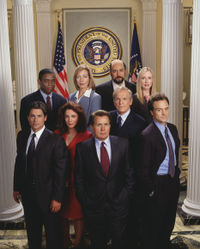
Sometimes coincidence throws up some interesting combinations. Take yesterday as an example. The big news of the day was the verdict in the trial of Saddam Hussein, and more specifically the sentence of execution. More4 has recently started showing the excellent West Wing from the beginning, and last night they got to Take This Sabbath Day which focuses on President Bartlet, a devout Roman Catholic, as he struggles to decide the fate of a man convicted of two murders. Throughout the episode you get many of the major characters in the programme stating their position, and there is a very moving final scene with President Bartlet talking with his priest, who he has been trying to contact since the beginning of the episode.

Certainly on an occasion when opinions on the death penalty are being discussed in the media, especially as a result of the reaction of many in Europeincluding our own Prime Minister – and the Church to the sentence, it serves as a good reminder of the issues, and also how Christians deal with them.

Fly Tipping by J R Hartley

Every so often I catch an edition of Rogue Traders, a BBC consumer show that uses secret filming to trap unscrupulous tradesmen. In the past it has been everything from solar panel salesmen to gardeners, and is usually a catalogue of dodgy selling techniques, and shoddy workmanship.

Tonight, the subject of the programme was fly tipping, a recurring problem all over the country, and something that our local councils have to spend large amounts of our money to deal with. One of the underlying reasons for people fly tipping is that to dump any commercial waste at a suitable site in the UK, commercial companies dumping waste are charged a landfill tax – essentially they have to pay to dispose of the rubbish – therefore it’s a lot easier to dump it for free somewhere out of sight and pocket the cash, which of course is why it’s such a problem.

Watching the programme I was expecting to see things like the example they showed of a skip hire firm burning waste in an area of outstanding natural beauty, but the other firm featured was quite impressive in the audacity of where they chose to dump the waste. It is worth mentioning as well that this other example had also recognised the presenter of the programme in his disguise and still illegally dumped the rubbish – the programme even had pictures of him doing it!

The programme had hidden a selection of tracking devices in the rubbish they asked to be cleared in order to track it’s movements after it had been removed. In this case the firm was operating in Barnet, but rather than dump the rubbish out in some rural spot, they instead dumped the rubbish in somebody else’s drive elsewhere in the local area. There didn’t seem to be any particular plan, the driver just seemed to have driven around until he found a likely looking spot, tipped out the contents of his truck and driven off. I was just open mouthed at it, especially when, even having been suspicious that he was on the programme, he did it again. The other amusing irony of the whole programme is that the secret filming also included the driver discussing with his mate how he was faking a back injury to claim incapacity benefit too.

The irony of all of this illegal dumping is that residents have already paid for disposal of a lot of household waste as part of their council tax. Unfortunately the exact service offered is up to each local council and varies across the country. For example our local council will collect everything from your old fridge-freezer to builders rubble. They used to collect limited items for free, but they now levy a charge. Other councils are more limited in what they will take. The real issue for householders now though is that in an effort to crack down on fly tipping some councils are going after people who hire disreputable firms, alongside the firms themselves. Take a look at this announcement from Swale Borough Council:

The Government have given local authorities more powers to continue their war on waste. Householders who use unlicensed waste carriers to remove their waste can now be prosecuted and fined up to £5,000, whether they do it knowingly or unknowingly.

Commercial fly tippers rely on householders and businesses not asking questions or checking registration details and therefore a duty of care is being placed on householders to take all reasonable steps to ensure that their waste is disposed of legitimately. Fly tippers can make huge sums of money by dumping waste, often in multiple lorry loads.

Essentially the onus is being passed back to the person responsible for the waste to ensure that the person they hire to dispose of it, disposes of it properly. Whilst the fly tipper may be long gone, the authorities will now come back to the source of the rubbish whether they knew it was going to be fly tipped or not. So if you have a lot of rubbish to get rid of it’s up to you to ensure that you get a reputable firm or risk a £5000 fine if they dump the rubbish illegally.

fly-tip east lond 2 originally uploaded by rUd?.