Category Archives: Politics

Postings related to elections and general political stuff

Government Moving to Tax Personal E-mail?

Craig Murphy highlighted this article from yesterdays Times, which flags up a change in the tax rules brought in by the recent budget. Whilst in computing terms most coverage concentrated on the loss of the Home Computing Initiative that encouraged home computer ownership by offering a tax break on the purchase cost, in some ways this part of the finance bill has the potential to be much more worrying.

Effectively the move seems to be going after companies that give employees a computer as part of their job, which then also gets used for general usage. For example a salesman or consultant that is given a laptop, and then at night uses his laptop at home for personal stuff, maybe checking his hotmail account, or doing a bit of online banking, essentially removing the need for a home computer. Under the new rules, this would be regarded as a benefit, and both the employee and the company taxed accordingly.

The issue to which the article in the Times alludes is that the legislation states that computers are exempt if usage is ‘not significant’, so it entirely depends on where you draw the line, and what you define as personal usage. Certainly with the fairly vague definition given in the legislation it has the potential to be a massive minefield for employers and employees, with the possibility that someone sending personal e-mails from a work computer could land both themselves and their company with a tax bill, depending on the definition of significant usage. Certainly whether it does end up being a tax on e-mail or not, it seems like a great opportunity to grab a nice lot of extra cash for the Treasury, and one that up until now has sneaked under the radar of most commentators.

The amusing thing is that now the government is now backtracking, saying that the chances of having to pay the tax are virtually zero – but if that is the case, as Craig says why bother to bring in the rule at all?

Is Climate Change a Reality?

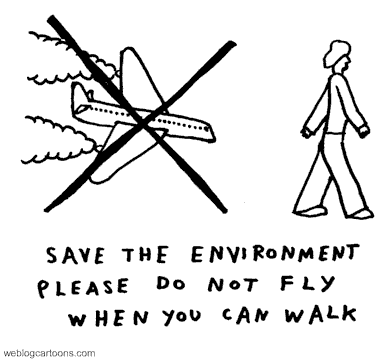
If you read Dave Walker’s Cartoon Blog you may have seen that he picked up on my report of this weeks lent lecture with an appropriate cartoon. What is also interesting is that if you look at the comments on his posting, he’s also attracted attention from a North American group who maintain that there isn’t any climate change, going for a bit of free publicity.

I had a read through their site, which was really quite interesting, particularly in the context of some of the things that Professor James said on Wednesday night.

As I’m not a climate specialist, I’m not going to try and either back Professor James, or try and debunk the science put forward by this group. If you are at all concerned I’d suggest that you run the names of the people in the group listed on this page through Google, and see what you find.

What I will say is that the one thought that strikes me over the whole thing, is a comparison of what would happen if we believed one group over the other and subsequently discovered that they were wrong.

Say we believed Professor James and the ‘Climate Change is happening’ group, and they turn out to be wrong, true you wouldn’t be able to get strawberries at Christmas, but ultimately we’d all be living in a less polluted environment. The effects would primarily seem to be economic.

However, look at it the other way. What if we believe the ‘There is no Climate Change’ lobby, and they are wrong. Say they are wrong and the levels of pollution that are being produced are sending us towards a climate change catastrophe. Take a look at the heat wave that occurred in France a couple of years ago was cited as the cause for thousands of deaths. Consider that on a global scale. If we mess up this planet, there is nowhere else that we can go – certainly no other planets in the solar system that could sustain life. This is it, if we mess this planet up, we’re all dead. I guess it depends how much of a gambler you are, but to be honest I’m not a gambler, and I don’t see that there is much of a choice.

‘Christianity, Christians and the Environment’

Revd Professor Ian James, ‘Christianity, Christians and the Environment’

Tonight we had the last of our Lent Lecture series (next week is a play in the Church), Revd Professor Ian James, who in his day job is a professor of Meteorology at Reading University, but is also a non-stipendary priest (who started off his talk by reminding us that on his previous visit he took our Easter dawn service – ironically because the person who introduced him tonight, Revd John Edwards, who had done it the year before, said he wouldn’t do it again…) in Bracknell, and the Diocesan Environmental Advisor, speaking about ‘Christianity, Christians and the Environment’.

He started with a review of the evidence of climate change, starting with a graph of the levels of Carbon Dioxide in the atmosphere, and covering the topics of rising average temperatures, melting glaciers, the rising sea temperatures that caused the worst hurricane season this last year, and who the biggest polluters per head of population are – the USA by a large margin, closely followed by Russia, Canada and Japan. Surprisingly Europe comes quite a way down compared to the US, although he did say that the reason for the reduction is that Europe is exporting a lot of it’s pollution thanks to the reduction in manufacturing industry that is now relocating to places like China and India. The BBC News site has an extensive section showing similar evidence of changes, and discussing many of the points that Ian made.

He then moved on to looking at why we as Christians should be concerned about the environment. He started this section by recalling many years ago how he had given a similar presentation to a group of local clergy, and was most surprised a few weeks later to be sat in a congregation whilst one of those clergy preached about how Christians should be doing other things rather than waste their time on trivial irrelevancies such as the environment! He gave a number of arguments as to why the Church should be focused on the environment, including the creation story in Genesis, but also by focusing on the key message of love for ones neighbour. As he highlighted, ones neighbour is anyone in the world, and as our decisions and actions in the UK affect the climate in distant parts of the world, we are showing love, or lack of it for our neighbours in the third-world by our over-consumption of energy in the west that is leading to rising greenhouse gases, and a changing climate that is certainly going to impact on the poorest parts of the world first. Following on from his story about the Bracknell clergy, he showed how things have changed a lot now. For example our Bishop now drives an environmentally friendly car, and the Diocese has taken the decision to cut emissions in line with the Kyoto agreement, even if the UK as a whole is going to fail to meet the targets.

Lastly he looked at ways that we both personally, and as a Church can help. He showed examples of the amounts of Carbon Dioxide produced by various activities, for example that the amount of carbon dioxide produced by a flight to Greece for a family holiday is equivalent to all the carbon dioxide produced by all the car journeys the average family undertakes in a year. He also showed the cost of our modern ability to get produce in our supermarkets from around the world – the amount of carbon dioxide produced to air freight 1kg of perishable fruit and veg to the UK is 6kg – whilst transporting 1kg of UK produced produce is 0.002kg. He also looked at the amount of energy that can be saved through replacing ageing Church boilers with more efficient, modern units, providing better insulation, and even the amount that is saved by switching the Church to a green energy tariff.

Following on from his talk we had a wide variety of questions. Most interesting from my point of view were his comments on the Electricity industry. Firstly he highlighted the ongoing campaigns against wind farms, often on the basis of the visual impact. Secondly he moved on to the topic of nuclear power. I have to say that having worked for SSE, my opinion on the nuclear option has changed. Lots of people will object to nuclear in principle, and suggest renewable sources such as wind, however with the ongoing opposition to such schemes, the chances of being able to generate enough through these sources is non-existent. Ian made an interesting point, that people often get small chances of a serious problem massively out of proportion. For example with nuclear energy there is a small risk of some sort of catastrophic accident, however to produce the levels of power required by the UK, the other options are gas or coal fired stations. Whilst there is less risk of a catastrophic accident, there is pretty well a hundred percent probability of continuing environmental damage, environmental damage that could lead to thousands, if no millions of deaths worldwide. His opinion is that if the world is to avoid any sort of unacceptably sudden and significant change in lifestyle, there is no way that it can be done without including nuclear power. He also briefly discussed small scale generation, highlighting the vast amounts of carbon dioxide produced by the production of solar panels, but suggesting a rooftop wind turbine as a viable option.

All in all it was a very informative talk, and certainly gave the parish a lot to think about. Hopefully as a result we can get the Church moved towards being more green sooner rather than later.

How Fair is Fair Trade?

Like many Churches and other organisations, St James recently managed to get awarded FairTrade status having ensured that we make use of fairly traded products such as the coffee and tea we serve after services.

With all the push to encourage more use of fair trade products, it was interesting to see tonight’s edition of the Money Programme, which looked at the whole phenomenon of fair trade, and particularly now that the large supermarket chains prominently stock fair trade goods.

It has to be said that the thrust of the programme was not at the concept of fair trade, but more a fairly heavy implication that the big supermarkets are using it as an opportunity to make more money from consumers. It is worth pointing out – and this was confirmed by the deputy director of the Fairtrade Foundation – that the only thing they guarantee is that the original producer of the produce is getting a fair price. Whilst most people are assuming that the extra money that we pay for fair trade products is going to the third world, it seems that the sums don’t quite add up.

The programme included several contributions from John McCabe, who has been saying for a number of years that supermarkets are overcharging for Fairtrade. The programme used the example of bananas, where they first looked at loose bananas, where the loose Fairtrade bananas, only sold by Waitrose, seemed to reflect pretty closely the difference in the amount the farmers were paid. However the pre-packaged Fairtrade bananas were significantly more expensive, and the supermarkets were unwilling to discuss where the extra money was going.

The programme then looked at coffee, where the average price of a Fairtrade brand was about 50p more than a regular packet – and yet the coffee growers see only a fraction of that. A professional coffee expert appeared and said that there was pretty well no difference between the regular and Fairtrade brands in terms of quality, nor packaging. Again the question was left hanging, where is all the extra money going?

John McCabe sums up the feelings of many people who buy fairtrade:

“What I’d like to see is the whole premium going back to producer, and that being the only difference between non Fairtrade and Fairtrade.â€?

When you think about it, to supermarkets such as Tesco, Fairtrade is almost just another product line, in the same way as they sell the value and Finest lines, organic and healthy eating lines. As with the other lines, it seems to be about marketing – labelling something as Fairtrade appeals to a growing group of consumers, consumers who are willing to pay a little extra to support people in the third world. It saddens me that it seems that big businesses that make millions of pounds profit appear to be charging the prices that people are willing to pay, and it seems generating more profit for themselves, rather than passing on the additional money the consumers have spent to the producers.

This idea that Fairtrade is becoming a marketing ploy has been further enforced by the news that Nestle, still subject to a boycott over their baby milk, and after years of claiming that Fairtrade was bad for the industry, have changed their mind, and are now producing Fairtrade Nescafe. Not surprisingly many people see this as nothing more than a cynical marketing ploy. As the program synopsis concludes:

The problem facing the Fairtrade Foundation is whether they can go mainstream without making too many compromises with big business, and whether core supporters will continue to stick with them.

That is an interesting question to ponder. I’m not buying Fairtrade in an effort to make super rich tycoons richer, I’m buying to help people who before fairtrade were unable to earn enough to live on. I’ve got no problem with the supermarkets making a profit on the goods, but I think it should be the same profit that they make on the non-fairtrade item, anything else would seem to be perverting the whole idea. Having said that, whilst we’re paying more than we maybe should, there is extra money going to those who need it – fairtrade does make a difference, even if big business is trying to make extra from it over here. Certainly I don’t think we should stop buying fairtrade. Instead, I hope that with increasing awareness there will be increasing information about how much of the extra we pay for fairtrade is actually going to those who need it – and how much is going elsewhere.
Church Fire Safety

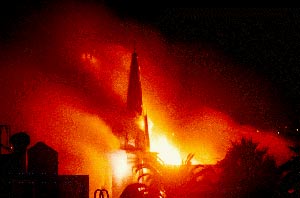
One of the downsides of being involved in the running of a church is that from time to time you get really daunting issues to deal with. One of those daunting issues turned up in my inbox this week – a really thorny issue with regards to fire safety.

In case you weren’t aware, last year the government passed the “Regulatory Reform (Fire Safety) Order 2005â€?. This snappily titled bit of legislation essentially sorts out all the fire safety related legislation into one place, so in theory makes the whole process of complying with the law a lot easier. However, one change that makes life considerably more difficult from the point of view of a church is that many of the rules that have previously not applied to churches are going to come in to force, more than that it will be a criminal offence to break key parts of the order.

In the case of our little church in Finchampstead, especially bearing in mind that our congregations are over 100 people almost every week, it has a big effect as whilst we have always been careful to provide fire extinguishers, detail escape routes at major services and so on, we now become subject to a set of rules that fundamentally the physical building cannot meet. The specific area of concern is the exits, which in terms of safety are badly placed, and in the case of the 1590 door, totally unsuitable because of it’s narrow size and treacherous steps. The other fundamental problem is that like the majority of church buildings, all the doors open in the wrong direction for a fire exit – fire exit doors must always open outwards.

What really adds to the complications is that our building is also grade one listed, and even without the listing, many would regard it as architectural and cultural vandalism to mess with historic external features such as the 1590 door purely for fire safety reasons. I can hear the arguments now – highlighting that there hasn’t been a fire in the past 1000 years so why are we proposing to change things now! Of course if we aren’t able to make the required building changes then we’re left trying to make other changes so that our use of the building enables us to meet the fire regulations.

Perhaps the only solace in this whole issue is that considering all the other churches around almost all of them will have the same problems – that the ancient buildings do not meet modern standards in terms of health and safety.

Incidentally, if like me, you are involved in a church and you had no idea of the new rules, there is a good leaflet available from the Church Safety web site. Unfortunately, despite planning to introduce these regulations in April, the government still haven’t managed to publish relevant official advice on compliance with the law. It may also be worth talking to your local fire service, as they will ultimately be responsible for ensuring that your building meets the requirements of the order.